Why GRP Appears on the Table: Weight, Insulation and First Price
The steel-versus-fiberglass question recurs in procurement files whenever a supplier presents an alternative that looks lighter and apparently cheaper than the familiar steel pole. Fairness requires starting with what GRP actually possesses. The material — a resin reinforced with glass fibres (GRP/FRP) — is far lighter than steel, which eases transport, handling and installation with simpler equipment; it does not rust in the metallic sense because it is not a metal at all; and it is inherently non-conductive. These are material facts, not marketing claims, and a comparison that denies them loses credibility before it begins. The correct engineering question is not "do these advantages exist?" but "when are they actually decisive, and what sits on the other side of the scale?"
The insulation argument in particular deserves a serious answer, not a dismissal. It is true that a GRP body is non-conductive, so a fault in the feeder cable cannot carry a dangerous touch voltage to its surface — a genuine safety property. A steel pole, however, is not left exposed to that risk in the first place: its electrical safety is achieved by an engineered system of earthing, equipotential bonding and residual-current protection, as detailed in the guide to lighting-pole earthing and electrical safety. The fair comparison is therefore not between an insulating material and an exposed metal, but between two complete systems that meet the same requirement by different routes, each with execution and inspection conditions that must be satisfied.
As for first price, it is usually presented as the decisive advantage, and here scrutiny is required. A GRP pole may cost less at small heights in some offers, and it may not; the price follows the resin system, the glass content, the manufacturing process, the brand and the freight — all variables in continuous motion. More importantly, the purchase price is one line of a cost that runs for decades; a full section of this guide is devoted to life-cycle cost and explains why the material decision cannot be closed on that single line.
The Structural Comparison: Stiffness, Deflection and Wind Loads per SBC 301
A lighting pole is a cantilever fixed at its base alone, and the governing load in its design is the wind per Saudi Building Code SBC 301, not the weight of the luminaire. It is in this equation that the essential difference between the two materials appears. Steel's modulus of elasticity is high, well known and uniform in all directions, giving the pole a stiffness that controls its deflection and sway under wind gusts. The modulus of a GRP laminate is substantially lower and varies with the resin system, the glass fraction and the fibre orientation — actual values are confirmed from the manufacturer's data and with a qualified engineer. The practical result is that a GRP pole of the same section deflects more, and controlling that deflection means enlarging the section or accepting greater movement at the top.
This deflection has consequences beyond appearance. Movement at the pole top shifts the luminaire's aiming, so the light distribution on the road fluctuates; on camera poles, sway becomes shake in the image itself, defeating the pole's purpose altogether. Add to this that GRP is anisotropic along its fibre directions, exhibits creep under sustained load and heat, and concentrates its weak points at connections and metallic inserts embedded in the wall — against a steel body welded longitudinally to a continuous base plate that behaves as a single structure. In either case the reference remains the same: a wind-load and deflection calculation to the latest edition of SBC 301, signed by a qualified engineer, not a general description in a supplier brochure.
Service Life in the Saudi Climate: UV and Cracking vs ISO 1461 Galvanizing
The Kingdom's climate examines the two materials in two different ways. GRP's adversary is not rust but the sun: intense ultraviolet radiation, heat and daily thermal cycling age the resin progressively — chalking and colour fade appear first, then fibre bloom at the surface and micro-cracking, and embrittlement creeps into the wall over the years. A gelcoat layer and UV inhibitors delay this mechanism without eliminating it, and their quality varies widely from one maker to another. The harder problem is that they cannot be verified by eye at delivery or measured with a simple field instrument; the condition of the laminate after a decade of sun is not a number the owner reads off a gauge, but an estimate that is difficult to document in an asset file.
Steel's adversary is well understood and measurable: corrosion. Its first line of defence is hot-dip galvanizing to ISO 1461 — a metallurgically bonded zinc layer that covers the inner and outer surfaces and provides cathodic protection at scratches — whose thickness is measured with a magnetic gauge and reported with the shipment. Over it, on request, an electrostatic powder coating adds colour and an extra barrier in what is known as a duplex system. The essential difference here is not that one material degrades and the other does not; both degrade. The difference is that galvanized steel's degradation is measurable, predictable, periodically inspectable and locally repairable, while GRP's is harder to detect and harder to document. For asset owners managing thousands of poles, that measurability is an operational value in its own right.
Practical Heights: Why GRP Is Rare Above 8–10 Metres
The bending moment at a pole's base grows steeply with height, because height lengthens the lever arm and enlarges the wind-exposed area at the same time. With a lower modulus, GRP reaches its practical ceiling early: deflection governs the design before strength does, and the maker is forced to enlarge the diameter and the wall until the weight and price advantages that justified the choice erode away. This is why GRP offers in the market concentrate at pedestrian and garden heights, and why a serious offer with documented calculations above roughly eight to ten metres is rare — a practical market observation, not a code rule, to be reviewed case by case with the project engineer.
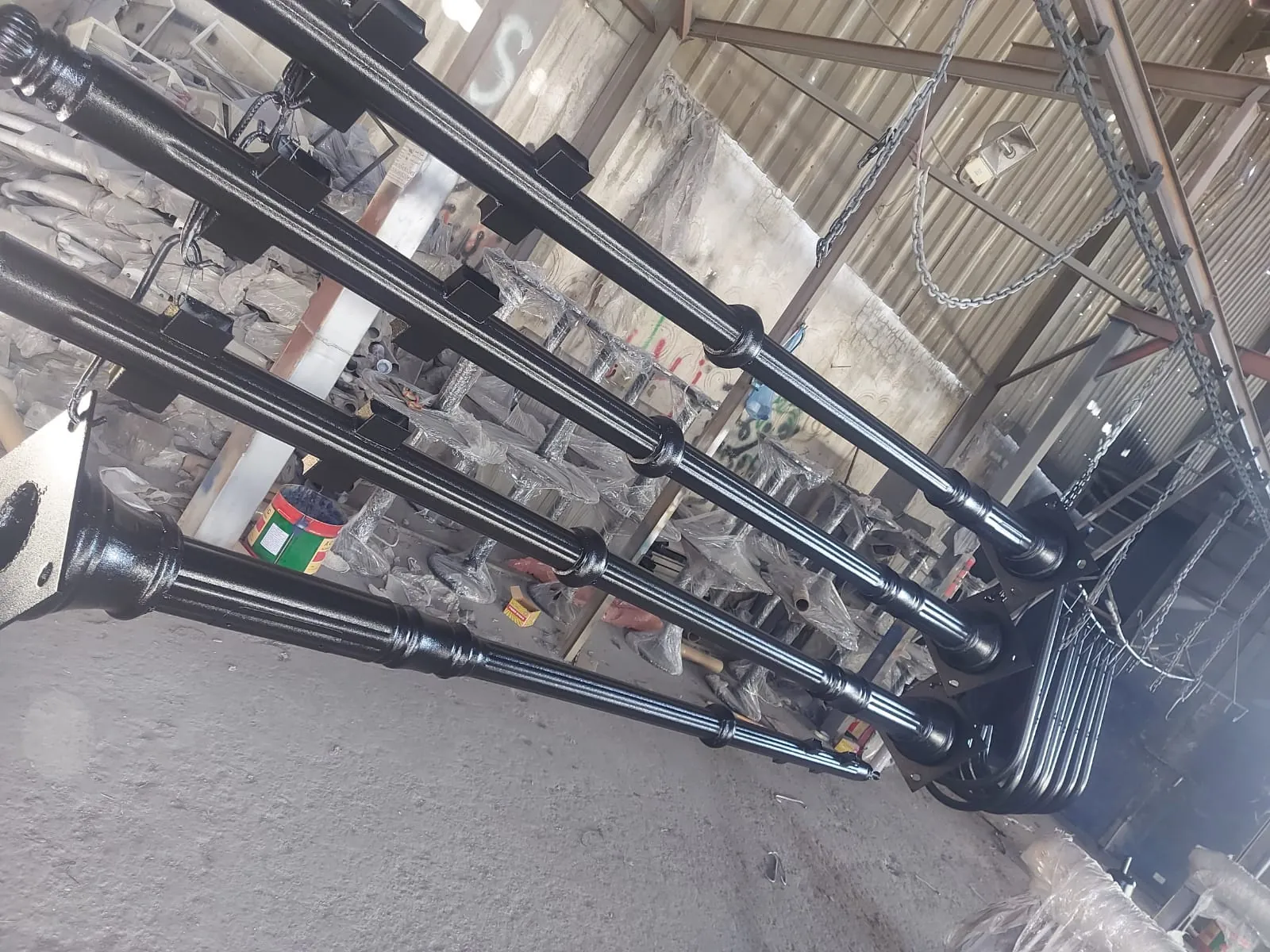
At road and street heights, the welded conical steel pole on a base plate remains the accepted solution in municipal and agency specifications — the range covered by steel street lighting poles across its full span of heights. It is worth noting that stiffness can decide the choice even at modest heights when the payload is vibration-sensitive: camera poles are the plain example, since pole sway blurs the image. A documented municipal approval in Buraydah for the supply of ninety 4-metre camera poles, among the documented projects, illustrates the point — a height nominally within GRP's range, yet supplied in steel — a practical illustration of how much stiffness and image stability weigh in this class of poles.
Installation, Foundations, Maintenance and Replacement
At the base, the two paths diverge in practice. A steel pole is erected on a base plate over anchor bolts cast into a concrete foundation — commonly specified to a reference such as ASTM F1554 — a standard detail that allows precise plumbing and lets the pole be dismantled, re-erected or replaced without breaking the foundation. GRP poles are often installed by direct burial or on bases proprietary to their maker; direct burial complicates later plumb adjustment and turns replacement into fresh excavation rather than unbolting and re-erection. In both cases, the foundation itself is not where savings are made: it is designed to the pole's moment and the soil's bearing capacity, whatever the material standing above it.
In service, the two materials behave differently in the face of damage. Steel shows its damage on its surface: a dent or scratch is assessed by eye and by measurement, repaired locally per the manufacturer's guidance, and the pole stays in service. GRP can conceal its damage: an impact cracks the laminate plies beneath a surface that looks sound, and laminate repair is rarely economic, so the matter usually ends in replacement. Fairness is due on the traffic-impact point: GRP's frangible break-up on impact may be treated as a passive-safety advantage in specific road classifications where the road authority explicitly requires it. Where it is required, it is a requirement to be met; where it is not, it is not a general argument.
Whole-Life Cost, Not Purchase Price Alone
You will find no price figures in this guide, because any number published today misleads tomorrow's reader: steel, resin and freight prices move continuously, and sections differ from one offer to the next. What endures is the method of calculation: the two materials are compared over an equal service period across seven items — supply price, transport and handling (where GRP's lightness genuinely helps), installation, periodic inspection, maintenance and repair, the expected number of replacements within the period, and the residual value at its end. On that last item lies a difference often overlooked: steel scrap is sold and recycled at a residual value, while disposing of end-of-life GRP laminate is a cost, not a credit.
The most recurrent trap in the comparison is weighing two unequal offers: a steel pole calculated for SBC 301 wind with a documented deflection limit against a GRP pole with no calculations attached at all. Before any price comparison, the scope must be equalized: the same height, the same luminaire area, the same design wind speed, a written deflection limit, and one service period over which the totals are computed. If the GRP supplier cannot produce calculations to these inputs, the comparison collapses before price is ever reached; there is no meaningful choice between a product proven by calculation and one described by advertisement.
When Is GRP Actually a Defensible Choice?
Engineering fairness requires naming the cases in which GRP is a sound choice, not merely a cheaper substitute. First, an explicit electrical-insulation requirement: near substations and energized equipment, or where the consultant mandates a non-conductive pole for a specific electrical condition — a legitimate requirement that GRP meets by the nature of its material. Second, severe chemical environments — industrial plants and treatment stations — that strain even galvanizing and would impose an intensive maintenance regime on steel. Third, weight-limited structures such as rooftops, bridges and plazas over basements, where every kilogram is a counted load. Fourth, low pedestrian-walkway heights where the loads are modest and the consequences of deflection are limited.
In these cases, with full documentation of UV-resistance data, deflection calculations and the warranty text, GRP is an engineering decision that can be defended. Even within the garden and walkway range, the choice remains open rather than pre-decided: steel garden poles cover the same heights with RAL powder-coat finishes, and the decision then rests on the site environment and the owner's maintenance philosophy. What cannot be defended is selecting GRP for road heights on purchase price alone and without calculations; that is not a saving but a silent transfer of risk from the supplier to the asset owner.
The Questions to Ask Before Award
Ask the GRP supplier: what is the UV-protection system — gelcoat, inhibitors, or both — and what accelerated-ageing test data supports it, and to which standard? Where is the deflection calculation at the design wind speed per the latest edition of SBC 301? What is the detail of the metallic inserts and the service-door opening in the wall? What is the warranty text in writing, with its items and exclusions? Which reference supplies exist in a comparable climate? Ask the steel supplier the counterparts: a galvanizing thickness report to ISO 1461, welding procedures and welder qualifications, the base-plate drawing with ASTM F1554 anchor bolts, the wind-load calculation, and the warranty in writing. The supplier who answers with documents enters the comparison; the one who answers with generalities is set aside.
In both cases alike: require the earthing and electrical-safety design signed by a specialist, delivery and batch-traceability documents, and a binding delivery period in the offer. Aktar Lighting Poles Est. manufactures steel poles at its Riyadh factory — conical rolling, longitudinal welding, hot-dip galvanizing to ISO 1461 and powder coating — and delivers Kingdom-wide within seven to fourteen business days per the quotation. Send your pole heights, quantities and project location through the lighting poles page, and the team returns a detailed offer with its calculations and warranty items; the consultation is free and non-binding.