Why finish matters more than steel thickness
The steel structure won't fail by itself — but its surface oxidizes. In a climate like Riyadh's or Jubail's, seasonal humidity, dust loading, and high temperature combine to wreck untreated poles. Finish is what determines the pole's real service life — not wall thickness.
Two main approaches dominate the Saudi market: hot-dip galvanizing, and electrostatic powder coating. Each has its right place, and each has cases where it doesn't suffice on its own.
Hot-dip galvanizing
The pole is dipped into molten zinc at approximately 450°C. The result is a metallurgically bonded alloy layer — not a surface coat that can peel. Typical thickness is 70 to 120 microns, per ASTM A123.
Pros: effective cathodic protection for decades, especially in humid or coastal environments. Small scratches don't matter — the zinc electrochemically protects exposed steel around them.
Cons: the bright silvery metallic finish doesn't suit every project aesthetically. Galvanizing alone also won't prevent color change over time (it weathers to a matte gray).
Electrostatic powder coating
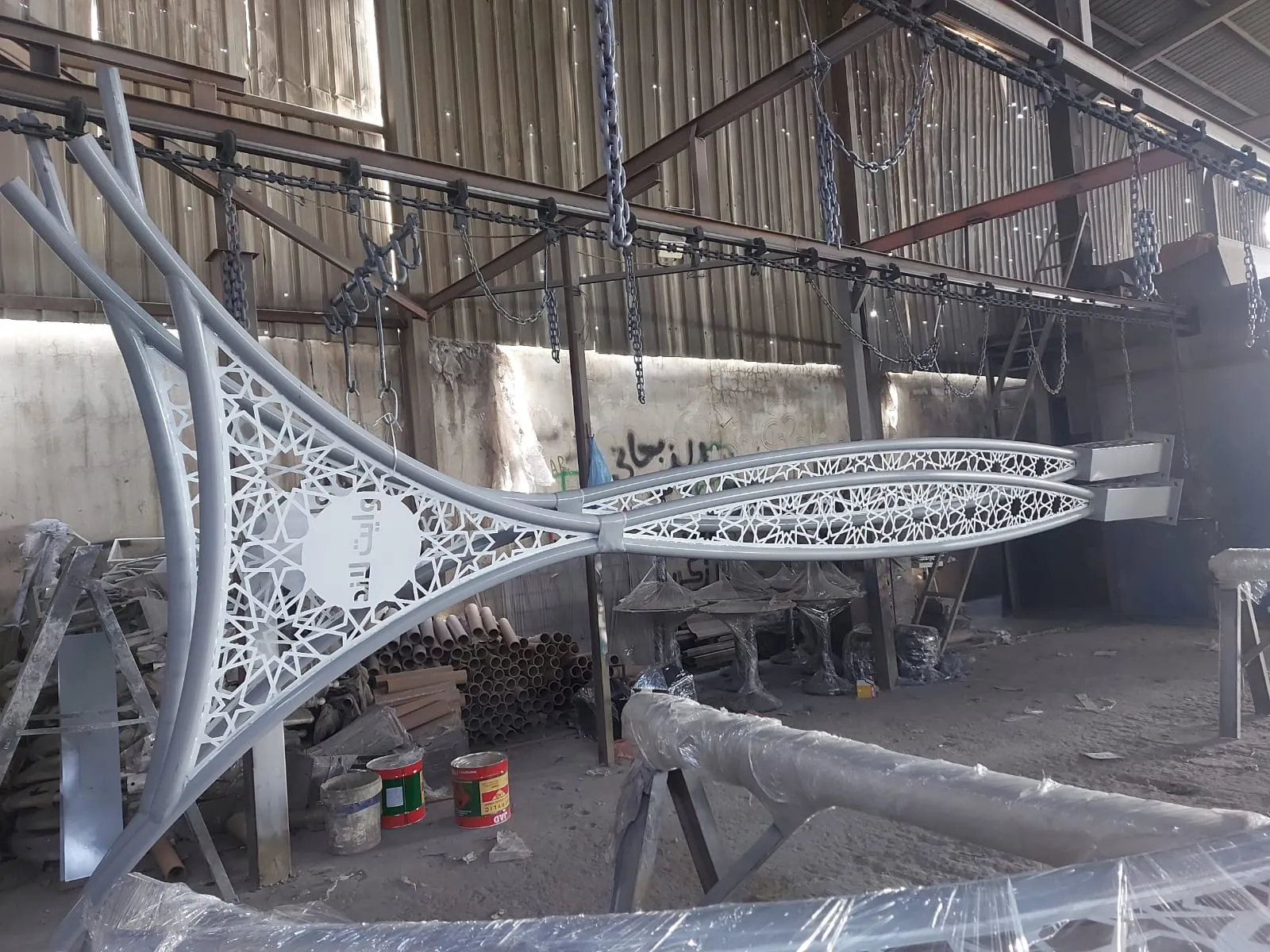
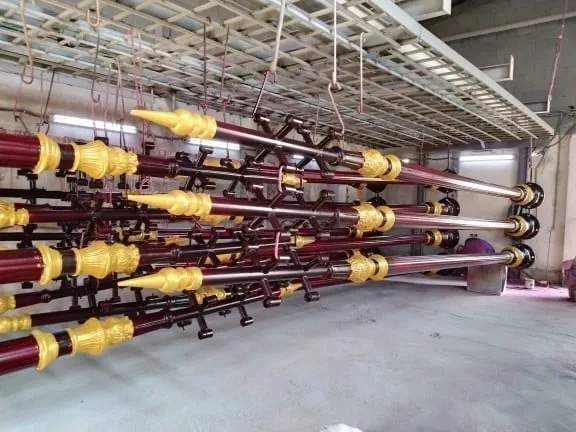
A polymer layer is electrostatically sprayed onto the surface, then cured in an oven. Color options are unlimited; finishes can be gloss, semi-gloss, or matte. Typical thickness 60 to 80 microns.
Pros: wide aesthetic range, good UV resistance, easy to spot and repair scratches locally.
Cons: paint alone on ungalvanized steel won't last long in Saudi conditions. A deep scratch opens a path for rust under the coating layer.
Recommended: a duplex system
For municipal and road projects targeting 20+ years of service life, we recommend "galvanizing + powder coating" — sometimes called a duplex system. It pairs the cathodic durability of galvanizing with the aesthetic appeal and color stability of paint.
For short-life private garden projects, powder coating on phosphate-treated steel is enough. Cheaper, but requires periodic maintenance every 5 to 7 years.
For stadium poles and harsh industrial sites, galvanizing alone is enough and more cost-effective — aesthetics aren't the priority.
How to verify quality
Ask the supplier for a zinc thickness certificate after galvanizing (measured with a magnetic micrometer). Request a Salt Spray Test sample for powder coating — 500 hours is the minimum threshold for outdoor projects in the Kingdom.
At Aktar, we allow quality inspection of the finishing process on every batch and document the results in the project file.
Frequently asked questions
Is powder coating alone enough for outdoor lighting poles in Saudi Arabia?
Electrostatic powder coating over ungalvanized steel is not advisable for long-life outdoor projects in the Saudi climate, since a deep scratch opens a path for rust that creeps under the coating layer. For short-life private garden projects, powder coating over phosphate-treated steel can be enough, but it typically needs periodic maintenance roughly every 5 to 7 years. For government and long-service projects, it is better to apply the coating over a galvanized layer (a duplex system) rather than on its own.
What is the difference between a duplex system and galvanizing alone?
A duplex system combines hot-dip galvanizing as a base layer with powder coating on top, pairing the cathodic protection of zinc with the color stability and aesthetic appeal of paint. Galvanizing alone gives effective cathodic protection for decades but keeps a silvery finish that weathers gradually to matte gray. A duplex system is therefore typically recommended for municipal and road projects targeting 20+ years of service life, while galvanizing alone is enough for stadium poles and industrial sites where aesthetics aren't the priority.
What zinc thickness is required for hot-dip galvanizing?
The typical zinc coating thickness in hot-dip galvanizing usually falls between 70 and 120 microns per ASTM A123, with the exact value depending on the steel thickness and the element category. The pole is dipped in molten zinc at approximately 450°C, forming an alloy layer metallurgically bonded to the steel that does not peel. It is best to verify the actual thickness with a magnetic micrometer and match it to what the governing standard text and the project specification require.
What is the Salt Spray test, and how many hours are required for outdoor projects?
The Salt Spray test is an accelerated corrosion test that exposes a coating sample to a salt mist to estimate its rust resistance in humid and coastal environments. As an indicative minimum for outdoor projects in the Kingdom, around 500 hours is commonly requested for a powder-coating sample. It is advisable to request the test report from the supplier alongside the zinc thickness certificate, and to confirm the exact requirement against the latest text of the standard governing the project.