Why there is no "standard price" for a lighting pole
When a contractor or buyer asks for "the price of a lighting pole," the question is in fact incomplete — exactly like asking "how much is a car" without naming the model, the engine, and the trim. A lighting pole is an engineered product manufactured to specification, not a shelf-ready commodity, and so the quote differs fundamentally from one supplier to another and from one project to another according to what the tender document actually requires.
Pricing in this field is built on the specification through a custom quote, not on a published price list. Two poles that look identical in height may be separated by a large cost difference because one has a heavier wall thickness, a stronger steel grade, and a duplex finish, while the other is at the bare minimum. That difference is neither "expensive" nor "cheap" — it is a difference in the product itself.
The aim of this guide is to break down the technical cost items that move the quote, so a contractor or buyer can read a quote with awareness and compare like with like. We will not state figures or amounts — because any number outside the context of a specific spec, quantity, and location is misleading — but rather explain what makes one pole cost more than another, and why.
The structural specification — the biggest cost driver in the pole
The base cost of the structure follows the quantity and quality of steel more than any other factor. Height first: every increase in height does not merely lengthen the tube — it typically requires a larger diameter and a heavier wall thickness to resist the wind moment, so the steel quantity rises faster than the extra metre alone. That is why a 12 m pole is priced at a tangible difference from a 6 m pole even when everything else is identical, bearing in mind that the exact sections are determined by a structural calculation against the region's wind loads (for example, the Saudi Building Code SBC 301 requirements).
Wall thickness and steel grade are decisive items, and often invisible in the quote. A pole with a 3 mm wall and one with a 5 mm wall may look identical from the outside, but the difference in steel weight — and therefore in cost and structural life — is large. As the guide to road-pole specifications under SASO and IEC explains, tall poles (roughly 10 m and above) commonly come with a wall thickness near 4 mm or more; but the governing value is not a fixed number in a single standard — it is the result of a structural calculation. Reducing the wall below what the design requires lowers the apparent price yet weakens the structural performance and may be rejected at site inspection.
The structural system is completed by the base plate and the anchor bolts: a steel plate typically 16 to 25 mm thick, with four to eight galvanized anchor bolts of about 24 mm diameter and up in many applications, with the actual values determined by the load calculation rather than by guesswork. The steel weight of these items is significant, and any quote offering a thinner plate or slimmer bolts than the calculation requires is, in reality, a different pole at a lower cost and a higher risk.
The finishing system — where price meets life
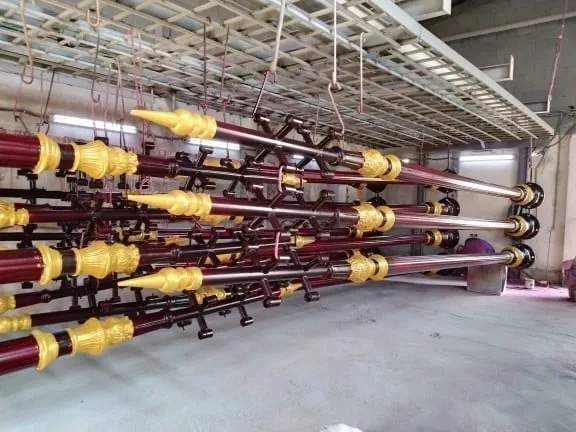
The finish is not a cosmetic touch but a protection decision that sets the pole's effective life, and it has a direct effect on cost. The differences between hot-dip galvanizing, powder coating, and the duplex system that combines them are not differences in colour alone, but in entirely different manufacturing processes and material costs. As the guide to hot-dip galvanizing versus powder coating shows, each approach has its right place and its cases where it does not suffice on its own.
Hot-dip galvanizing adds the cost of the molten-zinc dipping process and the zinc-layer thickness (typically around 70 to 120 microns for structural sections per the ISO 1461 / ASTM A123 grades, varying with steel thickness), but it buys cathodic protection lasting many years. Powder coating adds the cost of surface preparation, coating, and oven curing in exchange for colour, colour stability, and UV resistance. The duplex system — galvanizing then powder coating over it — combines the cost of both processes, which is why it is often the highest in price and the longest in life for projects targeting an extended service life.
The key point for the buyer: a cheaper quote may simply be a quote with a lower finishing system. Comparing a quote with powder coat alone on un-galvanized steel against another with a duplex system is comparing two different products with two different lifespans, not two prices for the same product. Always ask that the finishing system be stated explicitly, along with the reference zinc-layer thickness and the adopted galvanizing standard.
Pole type and level of customisation
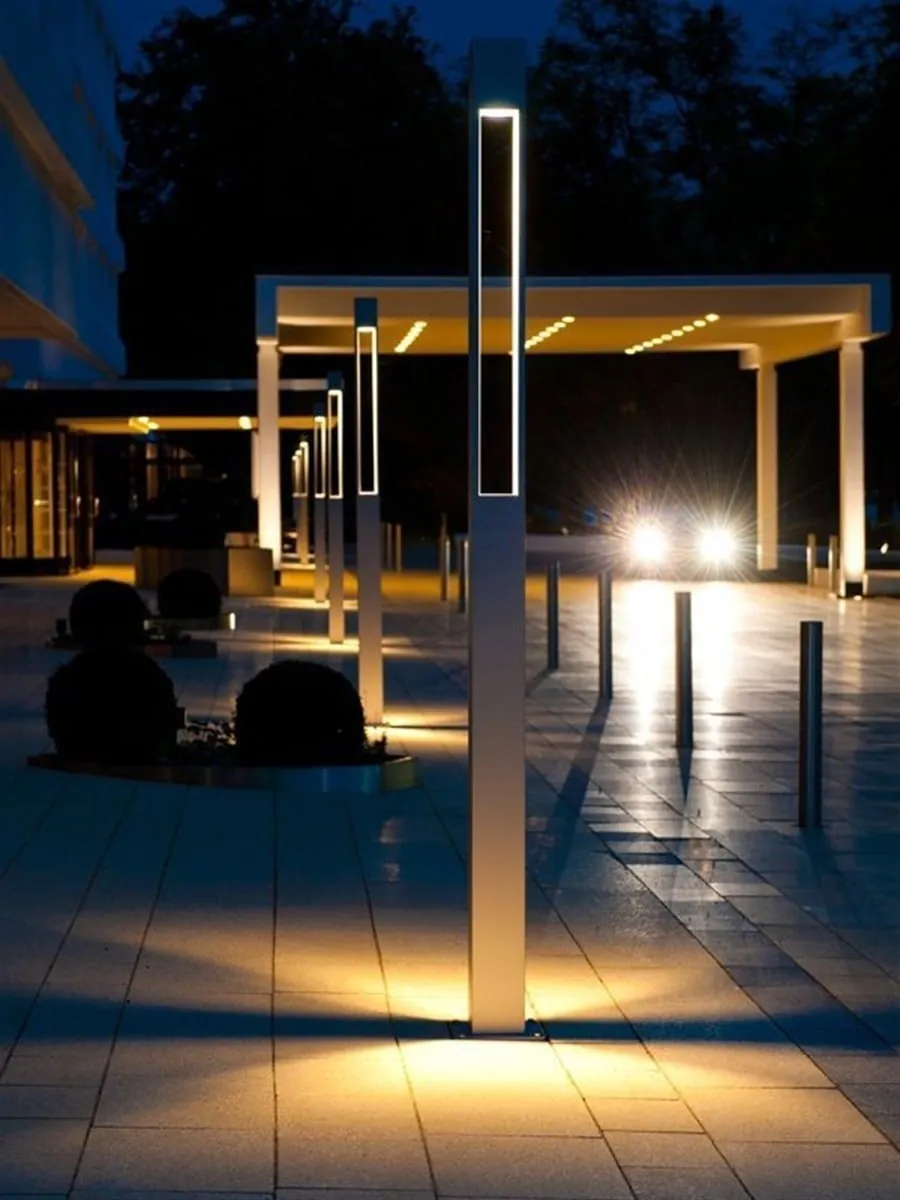
The spectrum broadly splits into three levels in terms of how customisation affects cost: the functional pole, the decorative pole, and laser cutting. The functional pole — such as street and road poles — is the simplest to manufacture and the closest to repeat production, so its unit cost is the most stable. As the guide to types of lighting poles explains, each family has its most suitable context, and choosing the wrong type for a site pays a cost with no added value.
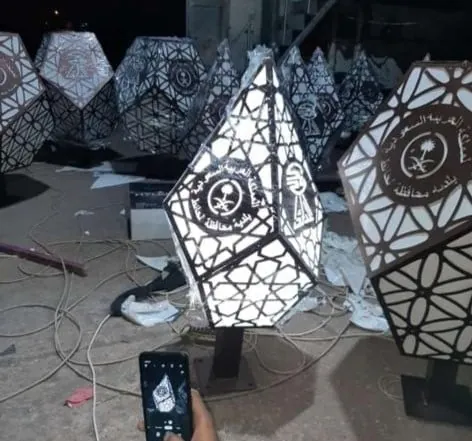
The decorative pole adds the cost of non-standard shapes, moulds, and details — a sculpted base, a lantern-shaped head, special geometric lines — and many of these require dedicated forming or casting tooling. The further the design moves from standard sizes, the larger the share of non-repeating manufacturing in the unit cost. Even so, that cost remains justified when the pole is an element of the site's visual identity rather than merely a lighting carrier.
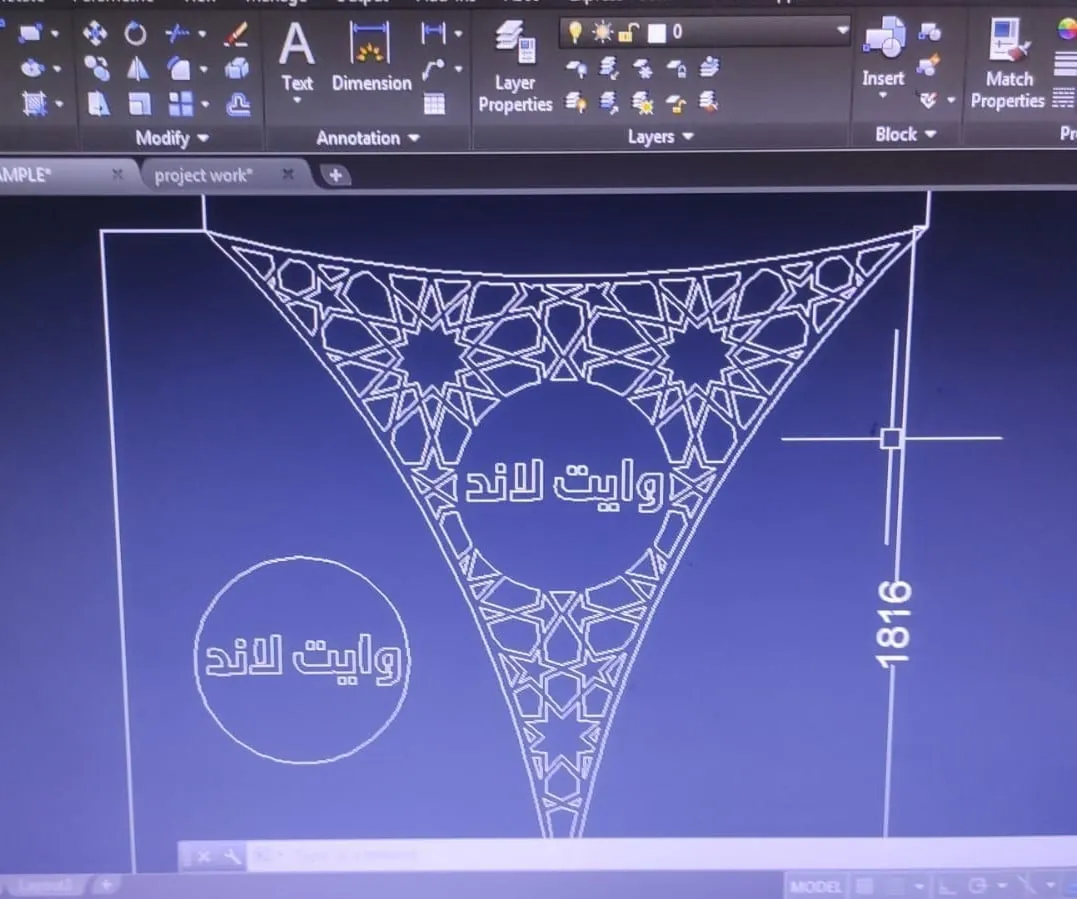
Laser cutting represents the highest level of customisation: fine patterning on the structure, ornamental motifs, or apertures that cast a luminous shadow. This level adds cutting-machine time, design complexity, and the cost of programming the pattern, and is priced according to the density and area of the patterning. The practical rule: customisation is not a cost flaw, but it should be requested deliberately so that it serves the project goal, rather than being added and then surprising the buyer in the quote.
The luminaire — a cost item separate from the pole
One of the most common sources of confusion in reading quotes is conflating the price of the pole with the price of the luminaire mounted on it. The pole carries the lighting but does not light; what lights is the fixture, and it has a specification and a cost entirely separate from the structure. The quote should therefore make clear whether the price is for the structure alone, inclusive of the fixture, or for the complete system with installation.
The fixture cost itself moves on its own factors: LED efficacy (lumens per watt), the light output required to meet the lux or luminance target, the optical distribution pattern, the colour temperature, the rating against dust and impact, the surge protector, and the control and dimming systems. As the guide to choosing the luminaire for road poles details, the fixture spec is derived from the road's lighting target — and verified with a photometric calculation (DIALux or AGi32) against the governing class — not from the wattage figure alone, and a cheap fixture with a lower spec can ruin the lighting of a sound pole.
For reading the quote: it is invalid to compare a quote that includes a high-efficacy, fully protected fixture against another that fits a bare-minimum fixture or omits its spec. Always separate the structure item from the photometric-system item, and ask that the fixture spec be written out in full, so you know exactly what you are buying under each line.
Quantity, tooling, and the minimum order
Unit cost does not move linearly with quantity. In metal manufacturing there is a fixed setup cost — preparing the moulds, calibrating the forming and cutting machines, and readying the galvanizing bath and the coating line — that is distributed across the number of pieces. The unit's share of this cost therefore falls as quantity rises, and rises markedly in small or single-piece orders.
Custom designs multiply the effect of quantity, because the dedicated mould or forming tool is made once and then amortised over the production batch. Distributing the cost of a decorative mould over 200 poles is fundamentally different from distributing it over ten poles. This is why a minimum order has a genuine industrial logic, not merely a sales policy — some designs are not economically viable below a certain quantity.
The practical advice for the buyer: if the project is phased, consolidating quantities into one batch with a unified specification may be more economical than splitting them across small, repeated orders that incur new setup each time. When requesting a quote, state the total expected quantity clearly, as it is one of the most important inputs to unit pricing.
Installation, foundations, and transport across the Kingdom's regions
Many quotes state the pole price and overlook that delivering and erecting it is a cost item in its own right. The concrete foundation alone requires excavation, reinforcement steel, and pouring; for tall road poles the anchor bolts must be embedded precisely using templates from the manufacturer, and the concrete must cure for a sufficient period before installation. Any shortfall here later shows up as a verticality deviation that is hard to correct.
Installation itself scales with height and weight: a short garden pole may be erected by a small crew, while a 12 m or taller road pole needs a crane of suitable capacity and a qualified team. The greater the height, the higher the cost of lifting and safety equipment, even before counting the fixture and the electrical work.
Transport is a factor that incomplete quotes overlook: the Kingdom is vast, and the cost of hauling a batch of poles from the factory to a distant site is not marginal — especially for long poles that require special transport. When comparing quotes, make sure each one states whether the price is ex-works or delivered to site, and whether it includes installation and foundations or not — a difference in the scope of supply alone can fully explain the gap between quotes.
Total cost of life — why the cheapest to buy can be the most expensive
The purchase cost is only the visible part of a pole's true cost. The total cost of life sums the purchase, the installation, the electricity consumption, the maintenance over the service years, and the likelihood of early replacement. A pole with a lower spec or a weak finish may be cheaper in the quote, but the buyer pays for it later in early rust, bending under wind, or a fixture that loses its output quickly.
This effect is amplified in tall poles. As the guide to stadium and large-yard mast engineering shows, the maintenance cost of a tall pole can exceed its original purchase cost over the service years, because reaching the head requires special equipment. A design that neglects ease of maintenance — or economises on the finish — turns an apparent saving at purchase into a much higher recurring cost.
The sound approach to comparison is to view the quote as an investment over the service life, not as a momentary purchase figure. When the specification is genuinely equal, the cheapest to buy is the most economical; but when the difference results from a reduction in thickness, finish, or fixture spec, the cheapest quote is often the most expensive over the horizon that matters to the owner.
How to read a quote and request an accurate one
To compare two quotes fairly, make sure they describe the same product. Ask that each quote state: the height, the tube diameter and wall thickness, the steel grade, the base-plate and anchor-bolt specification, the finishing system and zinc thickness, the pole type and level of customisation, the full fixture spec if included, the quantity, and the scope of supply (ex-works or delivered to site, with installation and foundations or without). Any quote reduced to a single number without these details cannot be evaluated with confidence.
An accurate quote starts with accurate information from you: the site type, the required lighting level or governing class, the number of poles, the geographic region, and any visual reference or tender document if available. The clearer the input, the more accurate the quote and the closer it is to execution without surprises, and the fewer the costly review cycles later.
At the Aktar factory we manufacture lighting poles in all their families — from decorative and garden to road, tall stadium masts, bollards, and laser-cut — and we match the structural specification, the finish, and the luminaire system to the requirements of each project, with the sections verified by structural calculation and the lighting by photometric calculation. Send us your site details, the quantity, and the required specification, and our technical team returns a detailed quote with clear line items and a written recommendation matching the spec to the project. The consultation is free and non-binding.
Frequently asked questions
Why don't you publish a price list for lighting poles?
Because a lighting pole is an engineered product manufactured to specification, not a ready commodity with a fixed price. The price is set by the height, wall thickness, steel grade, finishing system, pole type, fixture spec, quantity, and scope of supply, so any published figure outside this context is misleading. Pricing is therefore built on a custom quote for each project.
What is the biggest factor in a lighting pole's cost?
The structural specification of the pole is usually the biggest driver, led by height, tube wall thickness, and steel grade, because these set the quantity and weight of steel and are fixed by a structural calculation against the region's wind loads. Next comes the finishing system (galvanizing, powder coat, or duplex) and then the fixture spec. Quantity affects unit cost because it distributes the fixed setup cost across the number of pieces.
Does the pole price include the luminaire (the fixture) and installation?
Not necessarily, and the quote should state this explicitly. The pole is a structure that carries the lighting, the fixture is a separate item with its own spec and cost, and installation, foundations, and transport are further items. Always ask whether the price is for the structure alone, inclusive of the fixture, or for the complete system delivered to site — a difference in scope of supply alone can explain the gap between quotes.
How do I compare two lighting-pole quotes fairly?
First make sure both quotes describe the same product in detail: height, tube diameter and wall thickness, steel grade, base plate and bolts, finishing system and zinc thickness, fixture spec, quantity, and scope of supply. The cheaper quote may simply have a lower spec or a narrower scope, which is why you should look at the total cost of life and not the purchase price alone.