Why infrastructure projects need a deliberate lighting system
A municipal infrastructure project is not one type of lighting but several systems on a single site: roads that demand visibility and uniformity for the driver, plazas and public squares that demand even coverage, gardens and walkways that demand pedestrian comfort, and surveillance poles that demand height and stability for cameras running day and night. Each of these has a different functional objective, and therefore a different pole and specification.
Lighting in these projects serves two indispensable goals: safety and energy efficiency. Safety means a level of illumination and uniformity sufficient to see a hazard on the road, secure pedestrians in the squares, and run surveillance clearly; energy efficiency means achieving that safety with the least possible power — which in the Kingdom is now a regulatory requirement, not merely a recommendation.
The practical rule: a lighting system is built from the site's objectives downward — from the road class and required lighting level to the pole type, height, spacing, and finish — not from the pole's part number or price upward. Starting from price yields a project with uneven lighting, many dark spots, and high operating and maintenance costs over the long term.
Pole types in infrastructure projects
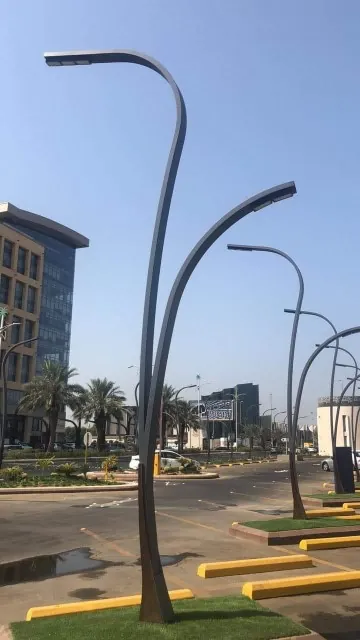
Road and street poles are the backbone of any municipal project: tapered or cylindrical steel poles, typically 6 to 12 metres tall, carrying one or two arms, with height and spacing set by a photometric calculation against the road class. Sub-roads and parking areas use lower heights of 4 to 10 metres. Choosing the family is detailed in our types-of-lighting-poles guide, and choosing height in the pole-height guide.
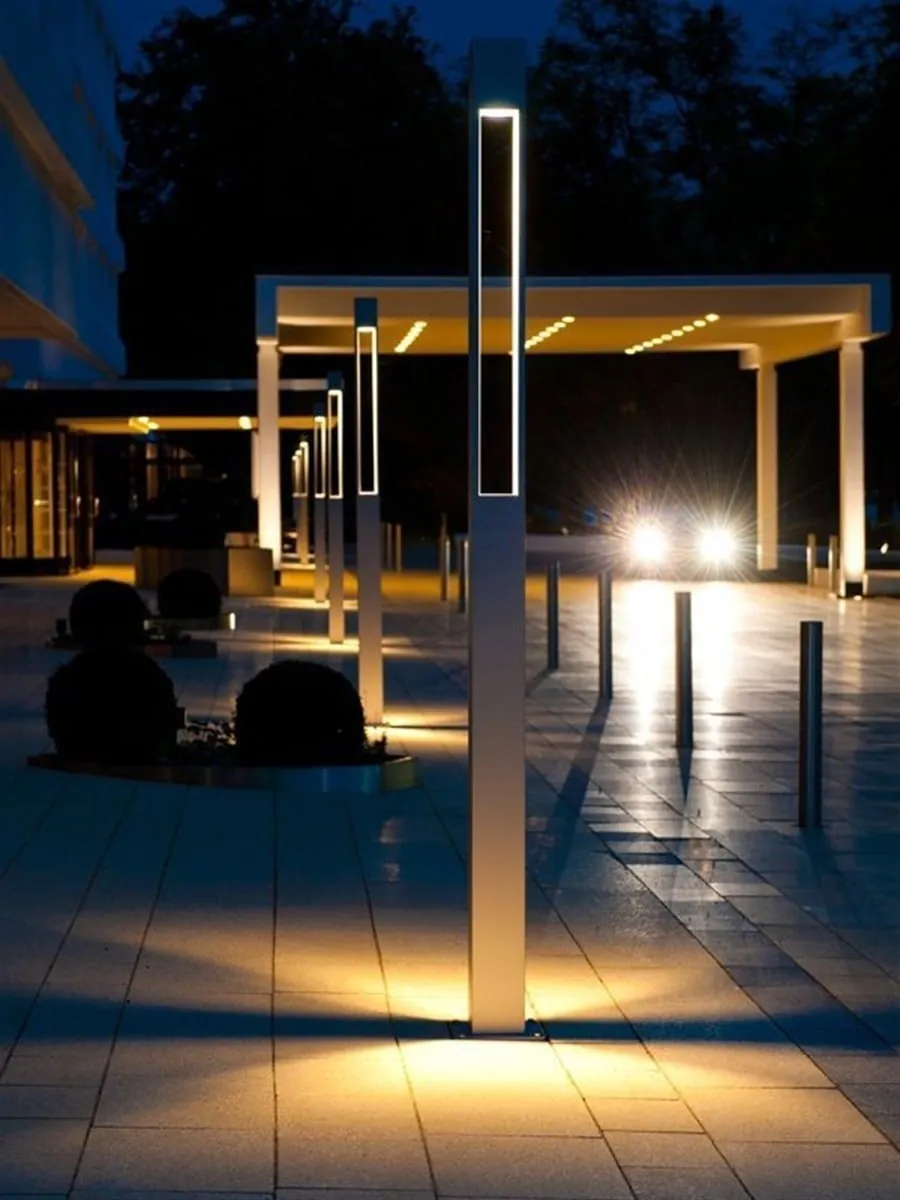
Camera and surveillance poles are a category of their own in smart-city and municipal-security projects: poles typically 4 to 8 metres tall that must be highly stable — because the slightest oscillation ruins the camera image — and must provide an internal cabling route, a service door, and a precise base. Garden and plaza poles, by contrast, are pedestrian-scale at 2 to 8 metres, focused on warm, comfortable light and highlighting a place's features without glare.
High masts for large yards, major parking areas, and sports facilities start at around 8 metres and reach 16 metres or more, carrying concentrated floodlight rigs at the head. Their design is governed by lateral wind force rather than vertical load alone, requiring independent load calculations and a dedicated maintenance approach. Many municipal projects mix all these types on one site; the key is keeping the finish, colour, and style consistent within each zone.
The specifications and standards governing government projects
On energy efficiency and functionality, SASO 2927:2019 governs road lighting in the Kingdom; it is mandatory and its conformity is verified through the SABER platform. The standard classifies road lighting into classes M (motorised traffic), C (conflict areas and intersections), and P (pedestrians and walkways), and sets minimum efficiency levels and labelling and functionality requirements. The exact numeric values are confirmed against the latest text of the standard, detailed in our SASO and IEC specs guide.
On the luminaire's electrical safety, IEC/EN 60598 governs the fixture — part 60598-1 general and 60598-2-3 for road luminaires — and SABER conformity is supported by accredited test reports. On photometric class selection, EN 13201 and CIE 115 frame the criteria for lux, luminance, distribution uniformity, and Threshold Increment (TI) for glare, alongside the local project requirements of the Ministry of Municipal and Rural Affairs and Housing and the relevant municipality.
On structural loads, the Saudi Building Code (SBC 301) sets design wind loads by geographic region, varying between coastal, central, and exposed zones. The taller the pole and the larger the wind-exposed area of floodlights and arms, the greater the moment on the base, and the more the vertical loads, lateral loads, and moments must be supported by a stamped structural calculation. Bringing these four systems together before submitting a bid saves the entity expensive review cycles later.
Durability in the Kingdom's climate — galvanizing and the duplex system
The steel structure does not fail on its own, but its surface oxidises; and the seasonal humidity, concentrated dust, and high temperature of the Kingdom's climate make the finish — not wall thickness alone — what determines a pole's real service life. For infrastructure projects targeting a long service life, hot-dip galvanizing per ISO 1461 / ASTM A123 is the baseline, at a typical thickness of roughly 70 to 120 microns depending on the steel section category, with the required minimum confirmed against the standard's tables and the target service life; it gives cathodic protection that lasts for many years and is unaffected by small scratches.
When colour is part of the project's identity or the municipality's requirements, electrostatic powder coating is added over the galvanizing in what is known as a duplex system: it pairs the cathodic durability of galvanizing with the colour stability and UV resistance of paint. This is a suitable approach for road and plaza poles and municipal decorative projects, while galvanizing alone may suffice for harsh industrial sites where aesthetics are not a priority.
The trade-off between galvanizing alone and the duplex system, the cases for each, and how to verify treatment quality by measuring zinc thickness and salt-spray testing, is covered in detail in our galvanizing-vs-powder-coating guide. The practical rule for municipal projects: choose the protection strategy on the basis of target service life and environment, not lowest purchase cost, because the wrong finish is paid for in maintenance and replacement within a few years.
Technical documentation for tenders
In government projects, a genuinely compliant product can still be rejected if it is not supported by complete documentation; that is why a technical file accompanies the bid. Its first component is a SASO product-conformity certificate via the SABER route, and a galvanizing thickness test report per ASTM A123 / ISO 1461 with an on-site sample measured by a magnetic thickness gauge — since relying on a galvanizing certificate without documenting the measurement is one of the most common gaps in municipal projects.
The second component is a structural calculation stamped by a qualified engineer, covering vertical loads, lateral loads, and base moments per SBC 301, while accounting for arm shape and the wind-exposed area of the floodlights. Added to it is a statement of earthing and electric-shock protection requirements per the principles of IEC 61140, plus surge protection for the luminaire per recognised standards such as IEC 61643 or ANSI C136.2 when the specification brief requires it.
The third component is an ISO 9001 quality-management certificate for the manufacturing site, proving that conformity is not in a single sample but in a controlled, repeatable process across the project's batches. Preparing this file before submission — not after award — is what turns a sound technical offer into an accepted one, and spares the contractor rounds of review and field rejection.
Solar power for off-grid sites
Many infrastructure sites lie far from the grid: external link roads, city approaches, peripheral gardens and parks, and surveillance sites in areas with no electrical service. In these contexts, the cost of running cables and trenches may exceed the cost of an integrated solar system, making the solar pole — which carries its own panel and battery — a practical choice, with faster execution and no extensive excavation.
But solar is not always cheaper: in the Kingdom's climate a battery must be chosen with a thermal rating that withstands summer, a margin must be added to the panel's output to offset dust accumulation, and enough days of autonomy must be designed for consecutive nights without sufficient sun. In general, the farther a site is from the grid and the lower the required lighting load, the more solar makes sense, while high-lux highways and tall yard masts remain better suited to a grid connection.
The full trade-off — the components, the performance limits in the Kingdom's climate, and when solar is the right choice and when it is not — is covered in our solar-lighting-poles guide. The practical rule in infrastructure projects: evaluate each site on its own merits as a function of its distance from the grid and its lighting load, since a single project may combine grid-connected corridors and solar peripheries at once.
Examples of projects delivered by Aktar
In 2025, the Aktar factory supplied 250 decorative lighting poles 8 metres tall to the municipality of Ashwaq in the Tabuk region, through Modern Building Assets Company, a project supported by a completion certificate. In 2024, a supply of 60 decorative tapered poles 12 metres tall with twin arms, hot-dip galvanized, was likewise delivered to the municipality of Ashwaq through Ruya Al-Dar Contracting Company, under a documented supply contract.
In surveillance, the Anaam City development in Buraidah in the Qassim region received, in 2025, 90 camera poles 4 metres tall, through Raqami General Contracting Company, under a supplier-approval letter. In municipal decorative work, Arab Revolution Park in the Al-Baha region received, in 2025, 160 decorative poles in a wood-finish colour at heights of 4 metres and 1 metre, with 160 concrete bases, through Construction Cities Contracting Company.
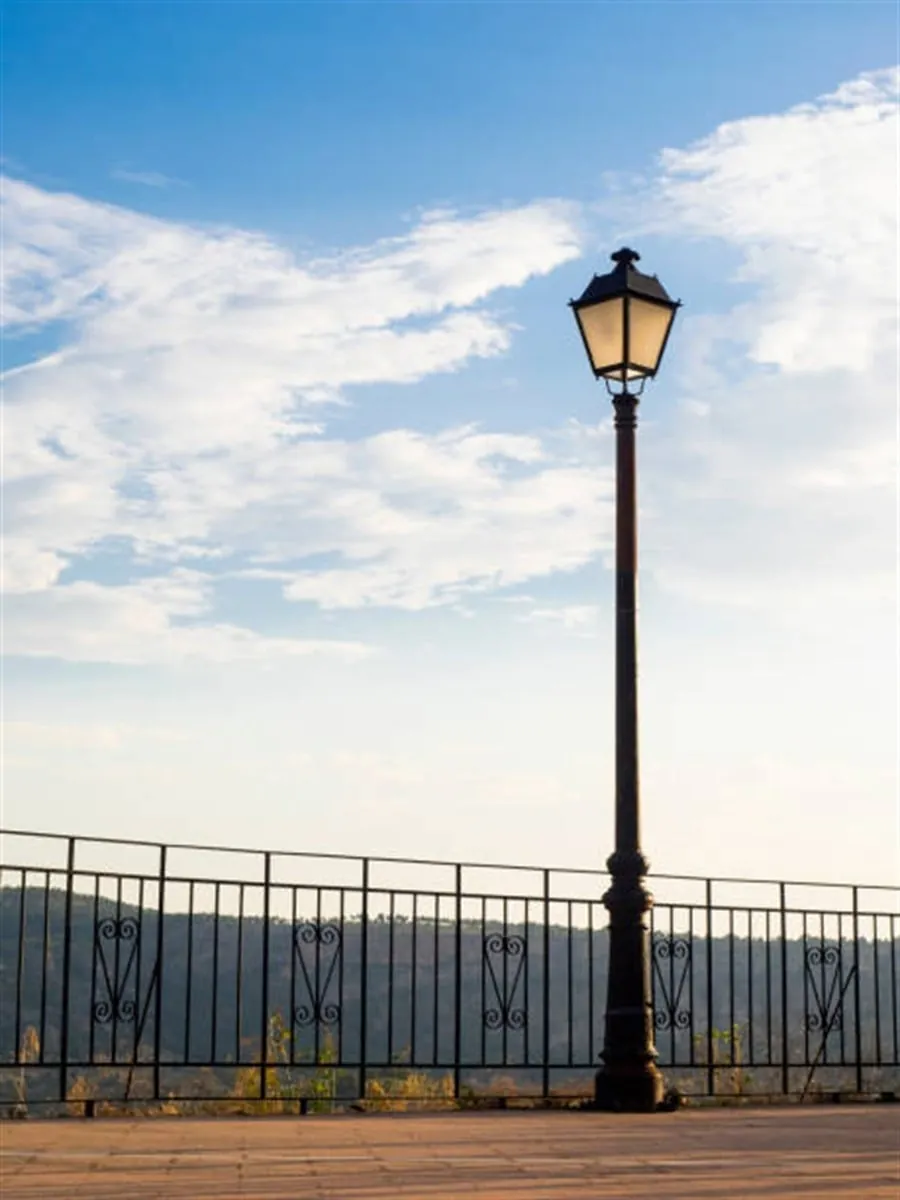
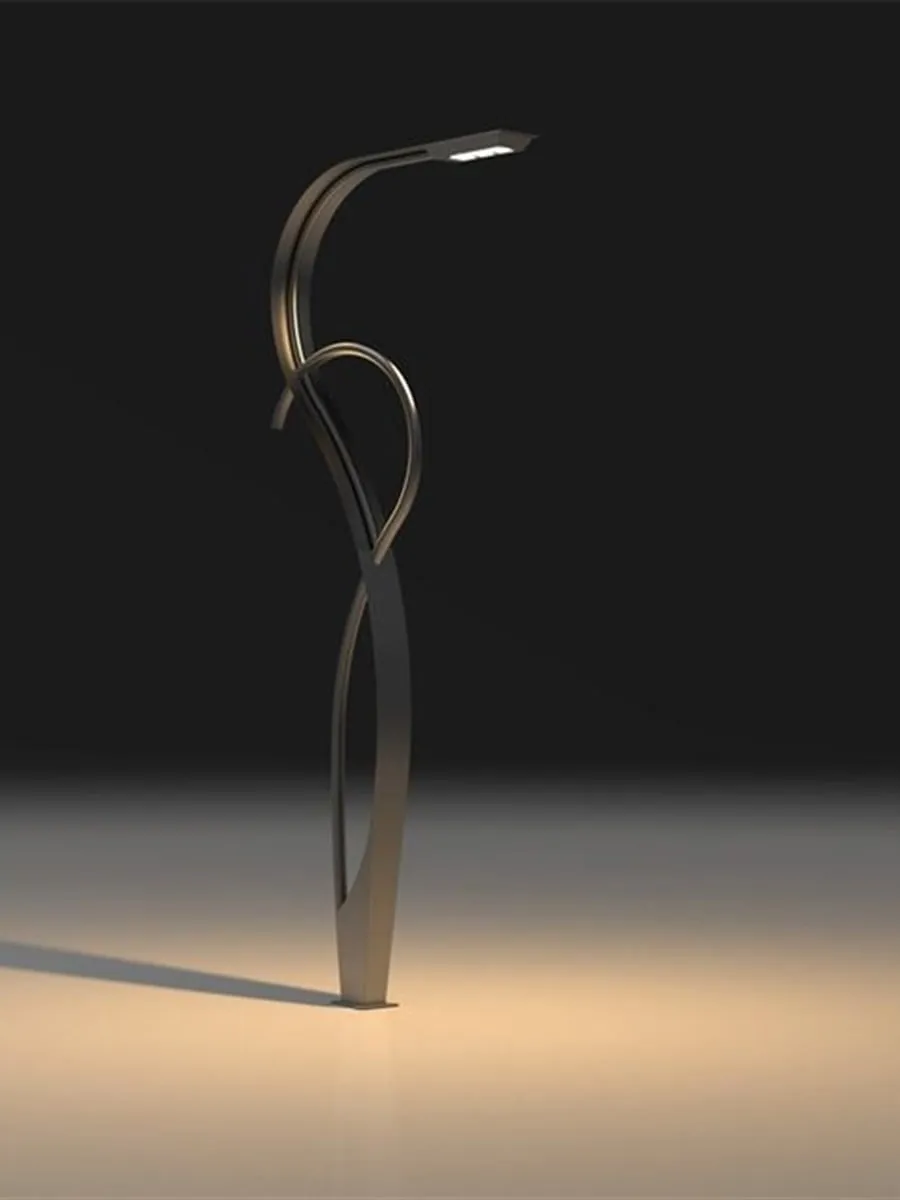
These examples cover the practical spectrum of infrastructure projects: decorative poles for roads and squares, tall galvanized tapered poles, surveillance poles, and coloured decorative poles with their bases — delivered with contractors and municipal entities across different regions of the Kingdom, and documented with certificates, contracts, and approval letters. Fuller details of this work are available on the selected-projects page.
Summary and a technical consultation
An infrastructure lighting system is built from objectives downward: the road class and lighting level first, then the pole type, height, and spacing, then the durability strategy suited to the Kingdom's climate, then the technical documentation that makes conformity provable in the tender. When this order is right, safety, energy efficiency, and a reasonable long-term cost follow naturally.
At the Aktar factory we manufacture the steel structure of lighting poles across all their families — road and street, surveillance, garden and plaza, high masts, and decorative — with hot-dip galvanizing, electrostatic powder coating, and laser cutting, and we match the specification to each project: the pole family, its height, finish, and spacing, together with the technical documents the tender needs. Send us the nature of the site, the required lighting level, and the specification brief if you have one, and our technical team will return a written recommendation on the suitable poles, quantities, and documentation. The consultation is free and non-binding.
Frequently asked questions
What are the mandatory standards for road lighting in Saudi government projects?
On energy efficiency and functionality, SASO 2927:2019 is the mandatory reference for road lighting in the Kingdom; its conformity is verified through the SABER platform, and it classifies lighting into classes M, C, and P. It is supported at the luminaire-safety level by IEC 60598, at the photometric-class level by EN 13201 and CIE 115, and at the structural-load level by the Saudi Building Code SBC 301. The exact numeric values are always confirmed against the latest text of each standard and the requirements of the relevant municipality.
What technical documents are usually required to supply lighting poles in tenders?
The technical file usually includes a SASO product-conformity certificate via SABER, a galvanizing thickness test report per ASTM A123 / ISO 1461 with an on-site sample, a structural calculation stamped by a qualified engineer covering vertical loads, lateral loads, and moments per SBC 301, and an ISO 9001 certificate for the manufacturing site. A statement of earthing and electric-shock protection per the principles of IEC 61140, plus surge protection for the luminaire, is added when the specification brief requires it. Preparing this file before submission rather than after award avoids rounds of review and field rejection.
What is the difference between surveillance poles and lighting poles in infrastructure projects?
A surveillance pole carries cameras rather than floodlights, is typically 4 to 8 metres tall, and above all must be highly stable because the slightest oscillation ruins the camera image, in addition to having an internal cabling route, a service door, and a precise base. A lighting pole, by contrast, has its height and spacing set by a photometric calculation against the road class and target lux level. Many municipal projects combine both types on one site while keeping the finish and colour consistent.
When are solar poles suitable for municipal infrastructure projects?
Solar is suitable the farther a site is from the grid and the lower the required lighting load — such as external link roads, peripheral gardens, and surveillance sites with no electrical service — where the cost of cabling can exceed that of a solar system. High-lux highways and tall yard masts usually remain better suited to a grid connection. In the Kingdom's climate, a battery must be chosen with an appropriate thermal rating, with a margin added to the panel's output to offset dust and to provide days of autonomy.