Why Park Lighting Is a Distinct Category From Road Lighting
The aim of road lighting is to let a driver see the carriageway quickly, over a wide area, and with strict uniformity. The aim of lighting a park or public space is fundamentally different: walking comfort, footing, a sense of safety, and the visual atmosphere of the place. The user here moves at roughly 4 to 6 kilometres per hour, not 60 or 100, so neither the high light level nor the rapid area coverage that roads demand is needed.
For this reason a park lighting specification is not derived from road classes but from pedestrian tasks: lighting paths, entrances, stairs and ramps enough to read the walking surface and nearby faces, and highlighting features and landscaping without flooding the place with light. The practical rule is that over-lighting a park is not more safety; it is usually glare, light pollution, and wasted energy cost.
The performance metrics differ accordingly. On roads, performance is judged by luminance (cd/m²) from the driver's viewpoint, whereas in parks and walkways it is judged by horizontal lux on the walking surface and by uniformity, with vertical or semi-cylindrical illuminance added where face recognition is needed for security. This is a different design philosophy from the outset, not road lighting scaled up or down.
The Right Light Level — Lower Lux, and Uniformity Is the Hero
Light levels in parks and public spaces are far lower than on roads, and they are framed by the pedestrian-class concepts (the P class) in CIE 115 and EN 13201. As indicative ranges, always verified with a photometric calculation (DIALux or AGi32) against the governing class and the owner's requirements: quiet paths and walkways around 5 to 10 lux, busier walkways and entrances around 10 to 20 lux, and active plazas, gathering and seating areas around 20 to 30 lux, with local increases at stairs, ramps and meeting points. These remain indicative figures, tuned to the exact values in the adopted class text.
But the number alone is not enough; uniformity is the most important factor in parks. The walking eye is bothered by sharp contrast between a bright patch and a dark one far more than by a low overall level, and the dark patches between poles are what create a feeling of insecurity, not a shortage of lux. So the specification states a minimum overall uniformity (the ratio of minimum to average, Uo, often not below roughly 0.25 to 0.4 depending on the class and as confirmed by the standard text), and the result is tested by photometric calculation before spacings are approved.
Here the design equation appears: the low level required tempts wider pole spacing, but excessive spacing breaks uniformity and leaves dark patches. The answer is usually more, shorter poles with lower-power luminaires and a wide, gentle distribution, not a few tall, powerful ones. This balance between height, spacing and light level is the heart of the guide to choosing pole height, and in parks it is resolved in favour of the human scale.
Pole Types for Public Spaces
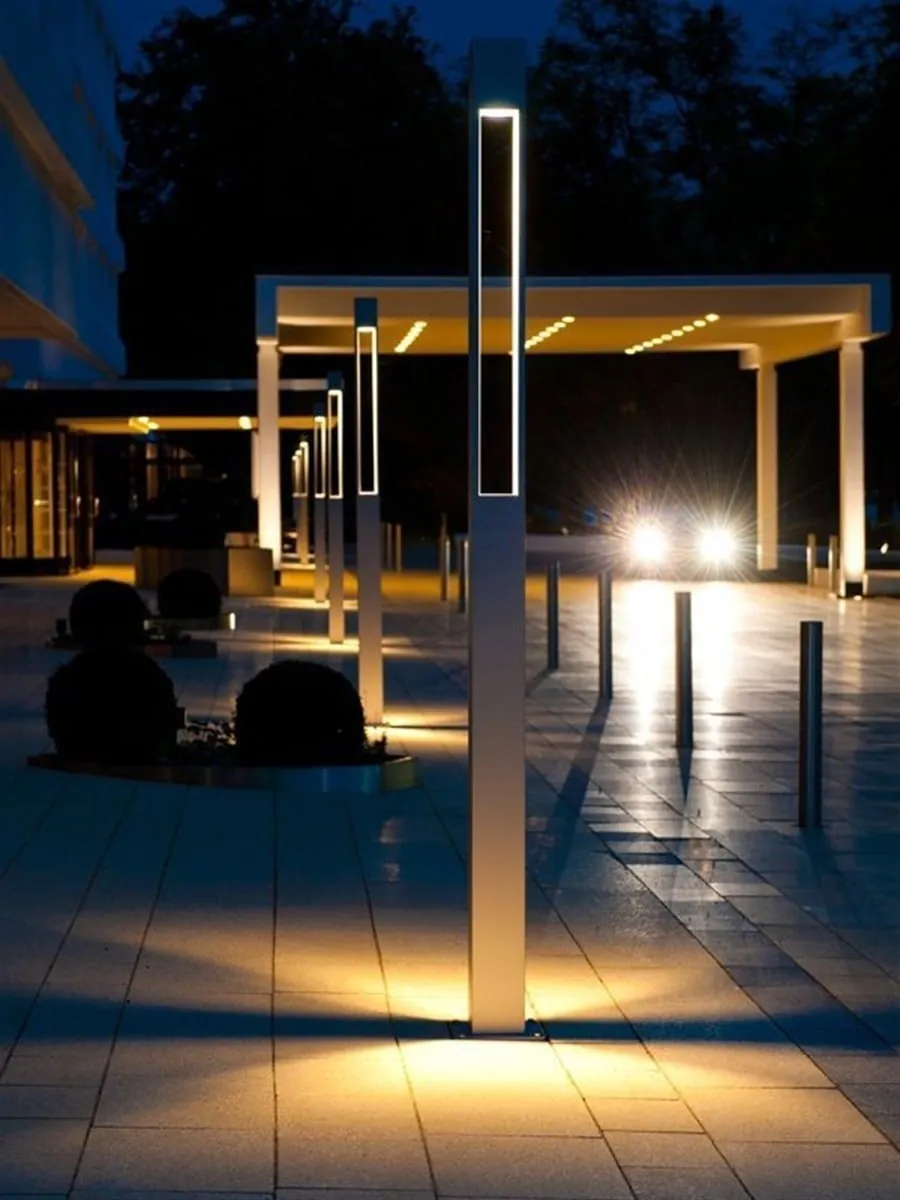
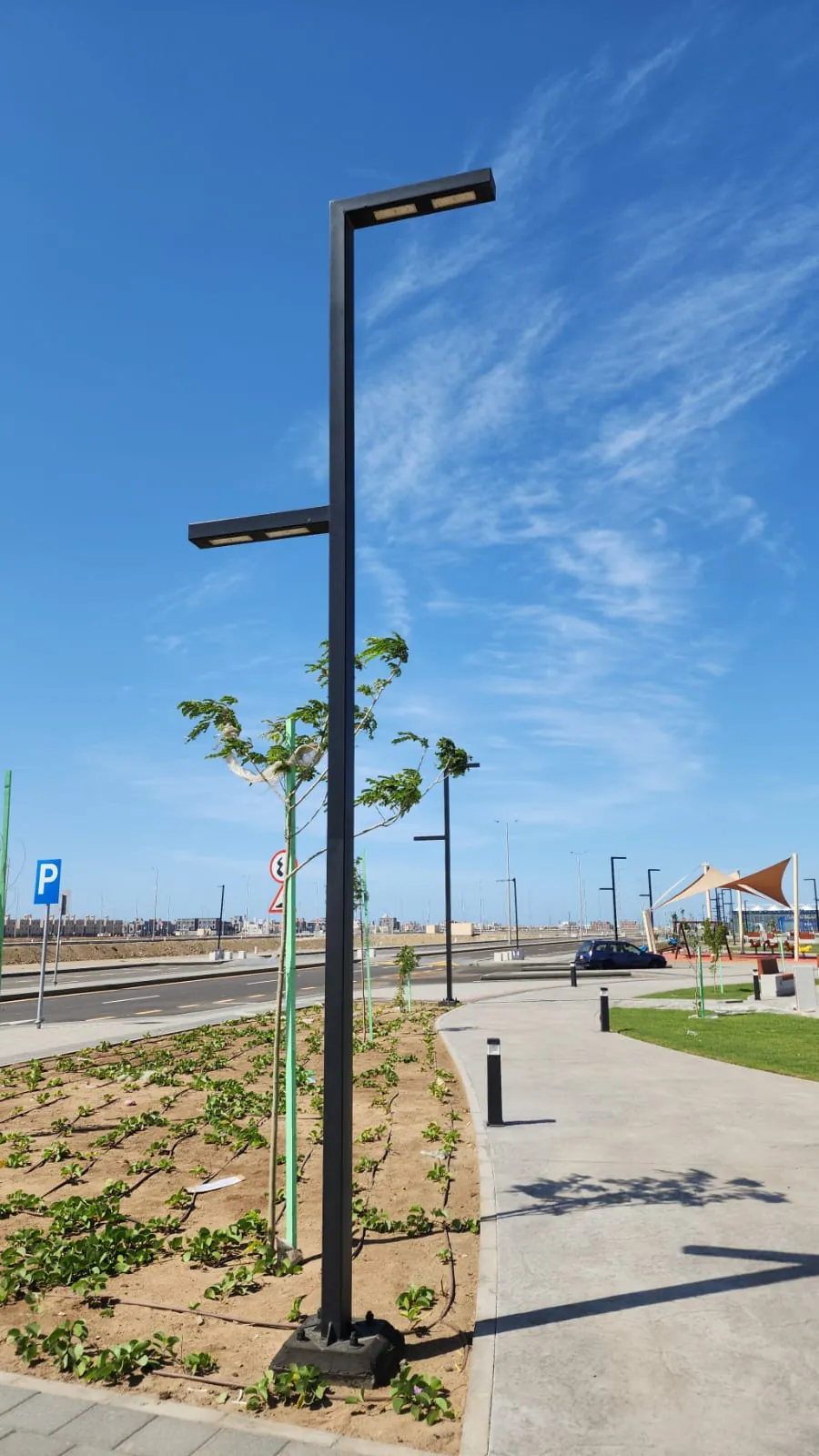
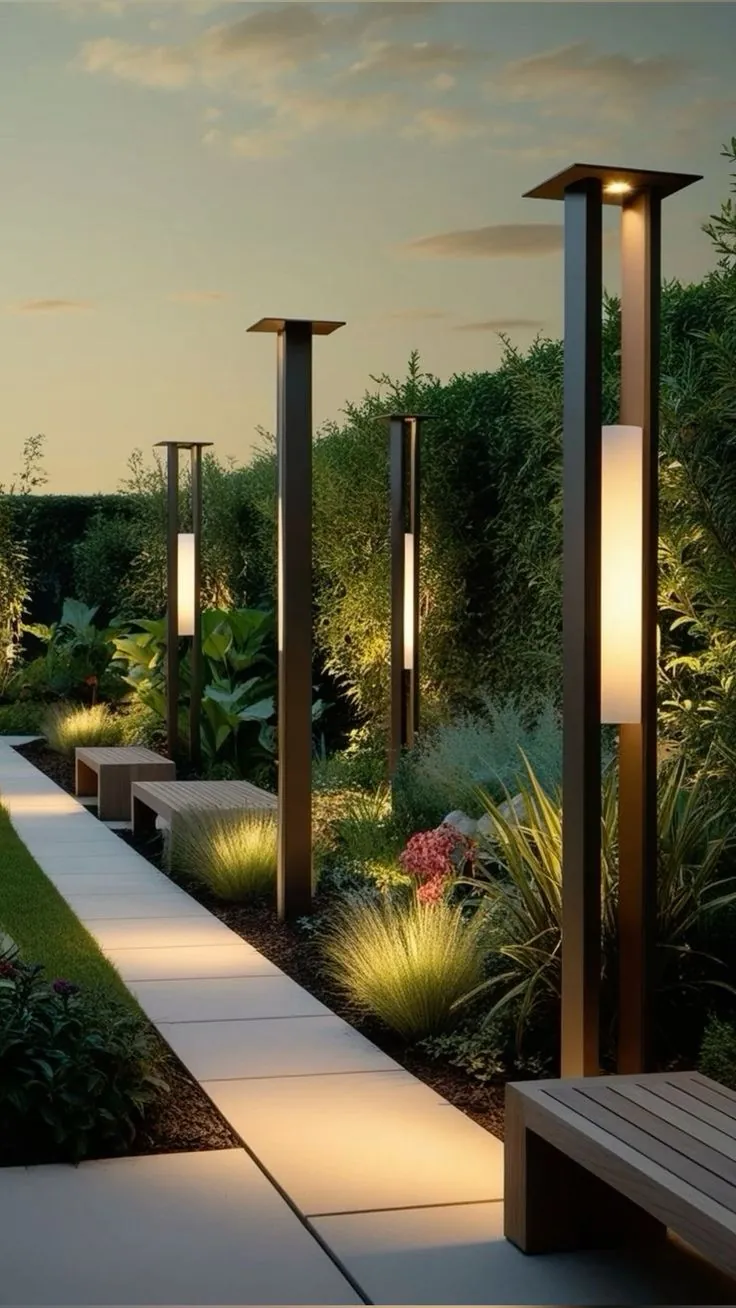
The core family in parks is the pedestrian, human-scale pole, with a height typically between 2 and 5 metres. This height places the light close to the walking surface, achieving the required level and gentleness without long throw, and keeps the visual mass of the pole proportionate to pedestrians and the surrounding landscaping rather than overwhelming it. This family and others are detailed in the guide to types of lighting poles.
Bollards (low poles) of roughly 0.5 to 1.2 metres light the walking surface directly and visually define the path, suiting path edges, entrances, the margins of green areas and seating zones. Their advantage is that they keep light low and near the ground, reducing glare in the line of sight and sending no light upward toward the sky; their limit is short reach, so they are used to complement pedestrian poles rather than replace them across wide areas.
Decorative poles are the element that shapes the identity of a place by day and night, allowing conical, ornamented or laser-cut forms and coloured finishes that harmonise with the project's character. The decision here is not purely functional but visual and identity-driven, treated in detail by the considerations in the guide to decorative pole design, provided that photometric performance and uniformity remain governed by calculation, not by form alone.
Colour Temperature and Respecting the Dark Sky
Colour temperature is a specification decision in parks, not merely a matter of taste. Warm light around 3000K or lower is generally preferred in parks and public spaces, because it gives a comfortable, inviting atmosphere, harmonises with green landscaping and natural materials, and reduces the blue content responsible for much of the environmental impact and skyglow. In ecologically sensitive areas or those near housing, a project may lower the temperature to a warmer amber.
High blue light (above roughly 4000K) has consequences beyond taste: its blue content increases skyglow, affects wildlife, insects and nocturnal activity patterns, and may be more disturbing to neighbouring residents. For this reason dark-sky recommendations (DarkSky) and the American Medical Association's 2016 statement on community outdoor lighting lean toward 3000K or lower in residential and sensitive environments, and toward warmer values in protected areas.
Colour temperature is part of the luminaire specification, not of the pole itself, since the pole carries the lighting but does not light. Selecting the luminaire — its colour temperature, certification evidence and distribution — is covered by the guide to choosing the lighting fixture; here the general principle is: choose the lowest colour temperature sufficient to read the walking surface and faces in the park, then tune the rest of the performance through optical distribution and shielding.
Reducing Glare and Light Spill, and Respecting Neighbours
Because a park user walks and looks horizontally — not ahead from a car — direct glare from an exposed luminaire at eye level is severely uncomfortable and undoes the very sense of ease that park lighting is meant to provide. This is controlled by choosing luminaires with good shielding of upward light and low emission at viewing angles, by a wide and gentle optical distribution that spreads light along the path rather than concentrating it in a bright spot, and by appropriate mounting height and shielding.
Light trespass beyond the site boundary is a particular problem for public areas adjacent to housing: light that crosses the park wall into neighbours' windows or up into the sky is wasted light and a source of complaints. It is addressed with full cut-off luminaires that prevent emission above the horizontal, by directing the distribution inward at boundaries, by lowering height near residential edges, and with side-shielding accessories where needed.
Respecting neighbours is an early design decision, not a later remedy: each pole's location, distribution pattern and colour temperature are placed so that light stays within the served area. Over-lighting does not increase safety; it creates sharp contrast that plunges the surroundings into deeper darkness and generates dark patches — the answer is uniformity and correct aiming, not more power.
Finishes, Durability and Solar Power for Off-Grid Sites
Park poles are exposed to spray, irrigation, humidity, direct ultraviolet radiation and pedestrian contact, so durability and finish are essential considerations, not cosmetic ones. Hot-dip galvanizing to ISO 1461 / ASTM A123 (with a coating thickness typically in the 70 to 120 micron range depending on section thickness and composition, the minimum being confirmed from the standard text) gives baseline protection against corrosion inside and out, and over it electrostatic powder coating is applied for ultraviolet resistance, colour stability and the desired appearance. Pairing the two methods, and which comes first when, is treated by the guide to galvanizing versus powder coating.
The ingress rating (IP) of the luminaire and gear should also be verified in an environment of spray, irrigation and dust, along with the impact rating (IK) at locations reached by pedestrians, children and equipment, where tampering and impact are likely. These details are part of the luminaire specification under IEC/EN 60598 and are written into the project document rather than left to assumption.
For parks and recreational grounds far from the grid, solar lighting is an attractive option because the low light load of public areas suits the battery and panel sizing and avoids running cables across wide green areas. But it is an engineering and financial decision with limits in the Kingdom's heat and dust and in the days of autonomy required — details that the guide to solar lighting poles addresses separately before a system is adopted.
How to Choose for Your Park or Public Space
Assemble the decision in this order: start from the function of each area (a quiet path, an entrance, a gathering plaza, stairs, a seating area) and set a target lux level and uniformity for it within the pedestrian class; then choose the right pole family (a human-scale pedestrian pole, a low bollard, or a decorative pole for identity) and its height; then set a wide, gentle optical distribution and a warm colour temperature around 3000K or lower; then control glare, light spill and respect for neighbours; then choose a durable finish and the power source (grid or solar by location); and finally verify spacings and uniformity by photometric calculation before approval.
The governing standards remain the same in essence: CIE 115 and EN 13201 frame the selection of the pedestrian class and the lux and uniformity levels, IEC/EN 60598 governs luminaire safety and the IP/IK ratings, and SASO 2927 (with exact values confirmed against the latest text and SABER platform conformity) frames the energy-efficiency requirements for street and road lighting products in the Kingdom, alongside the owner's requirements from the municipality or developer. Figures are always verified by photometric and structural calculation, not by estimate.
At the Aktar factory we manufacture decorative poles, human-scale park poles and bollards in their various types and finishes, and we match the pole, its height, distribution and colour temperature to the function of each area in the park. Send us the site plan, the required light level and the nature of the surroundings, and our technical team will return a written recommendation pairing the suitable pole type with the luminaire specification and spacings. The consultation is free and non-binding.
Frequently asked questions
What light level (lux) is appropriate for lighting parks and walkways?
Park levels are far lower than roads and are framed by the pedestrian classes in CIE 115 and EN 13201. As indicative ranges, always verified with a photometric calculation and tuned to the exact values in the class text: quiet paths around 5 to 10 lux, busier walkways and entrances around 10 to 20 lux, and plazas and gathering areas around 20 to 30 lux, with local increases at stairs. More important than the number is the uniformity that prevents dark patches between poles.
What is the right height for park lighting poles?
The core family is the human-scale pedestrian pole, typically between 2 and 5 metres, because it places light close to the walking surface and keeps the pole's mass proportionate to the place. It is complemented by low bollards (roughly 0.5 to 1.2 metres) at path edges. The relationship between height, spacing and uniformity is resolved by photometric calculation, and is treated in detail by the guide to choosing pole height.
What colour temperature is most suitable for parks and public spaces?
Warm light around 3000K or lower is generally preferred in parks, because it gives a comfortable atmosphere and reduces the blue content responsible for skyglow and environmental impact on wildlife. Dark-sky recommendations (DarkSky) and the American Medical Association's 2016 statement lean toward 3000K or lower in residential and sensitive environments, and toward warmer values in protected areas. Colour temperature is part of the luminaire specification, not of the pole itself.
Is solar lighting suitable for parks?
It is often suitable for parks and recreational grounds far from the grid, because the low light load of public areas suits the battery and panel sizing and avoids running cables across green areas. But it is an engineering and financial decision with limits in the Kingdom's heat and dust and in the days of autonomy required, and the guide to solar lighting poles addresses it separately before a system is adopted.