Why parking and commercial-area lighting is a distinct engineering decision
Lighting a parking lot and commercial complex is neither a scaled-down road nor a scaled-up garden; it is an application class of its own with its own tasks and criteria. In a commercial parking area three movements overlap in one space: cars moving slowly, manoeuvring and reversing; pedestrians crossing between rows carrying their purchases; and vehicles entering and leaving at gates and entrances. This overlap of low speeds and pedestrians in an open space is what makes the specification different from an open road, which serves only the high-speed driver.
Layered onto this safety task are objectives not present, to the same degree, on a road or in a garden: security (recognising faces and plates and supporting CCTV), the visual comfort of a shopper who spends time in the place rather than passing through it, and the commercial identity of a frontage that wants to appear lit and inviting at night. Lighting here is at once a safety tool, a security tool and part of the shopping experience — and each objective adds a constraint on level, distribution and colour temperature.
For this reason the parking and complex specification derives from outdoor work-and-traffic-area standards, not from road classes: it is framed by EN 12464-2 for outdoor workplaces with CIE guidance, while road lighting specs (SASO/IEC) serve the surrounding streets and grid-connected entrances. Distinguishing the two spaces from the outset is essential: the parking area is designed on horizontal uniformity and face recognition at low speed, whereas the adjacent road is judged by luminance from the fast driver's viewpoint.
Appropriate light levels — indicative lux and calculated uniformity
Light levels in parking and outdoor areas are framed by EN 12464-2 and CIE guidance and vary with traffic density and the nature of the lot. As indicative ranges, always verified by a photometric calculation (DIALux or AGi32) against the adopted text and the owner's requirements: light-traffic parking around 5 to 10 lux; medium parking and circulation aisles between rows around 10 to 20 lux; entrances, gates, payment points and congestion areas around 20 to 30 lux or more, with local boosts at pedestrian crossings, stairs and ticket kiosks. These remain indicative figures; verify the exact value against the latest edition of the text and the project class with a qualified engineer.
But level alone does not make a good lot; uniformity matters no less. A harsh contrast between a bright patch under a pole and a dark patch between poles tires the driver's and walker's eyes and hides obstacles, kerbs and pedestrians in shadow — and the dark patches between rows, not the lower average, are what create a sense of insecurity. The specification therefore states a minimum lighting uniformity (minimum-to-average ratio Uo), often not less than about 0.25 to 0.4 depending on the area class and as confirmed by the standard, tested by photometric calculation before spacings are fixed.
A security-specific dimension is added: recognising faces and plates requires a measure of vertical or semi-cylindrical illuminance, not horizontal alone, because a face is a vertical surface. This dimension also serves CCTV, which needs sufficient, balanced light to record usable images. This ties the parking specification directly to the camera and surveillance poles guide, since a camera over an unlit scene full of harsh shadows and glare is worthless.
Typical heights and distribution arrangements
Parking and commercial-complex pole heights usually range from 4 to 10 metres, and the choice within that band is settled by lot area and the required distribution pattern. Lower heights (around 4 to 6 metres) suit small lots, aisles and areas near the frontage where a human-scale light close to the ground is wanted, while greater heights (around 8 to 10 metres) serve wide open lots because they cover a larger area with fewer poles and improve uniformity. Choosing the right height as a function of spacing and coverage is the core of the pole-height selection guide and is settled here by calculation, not estimation.
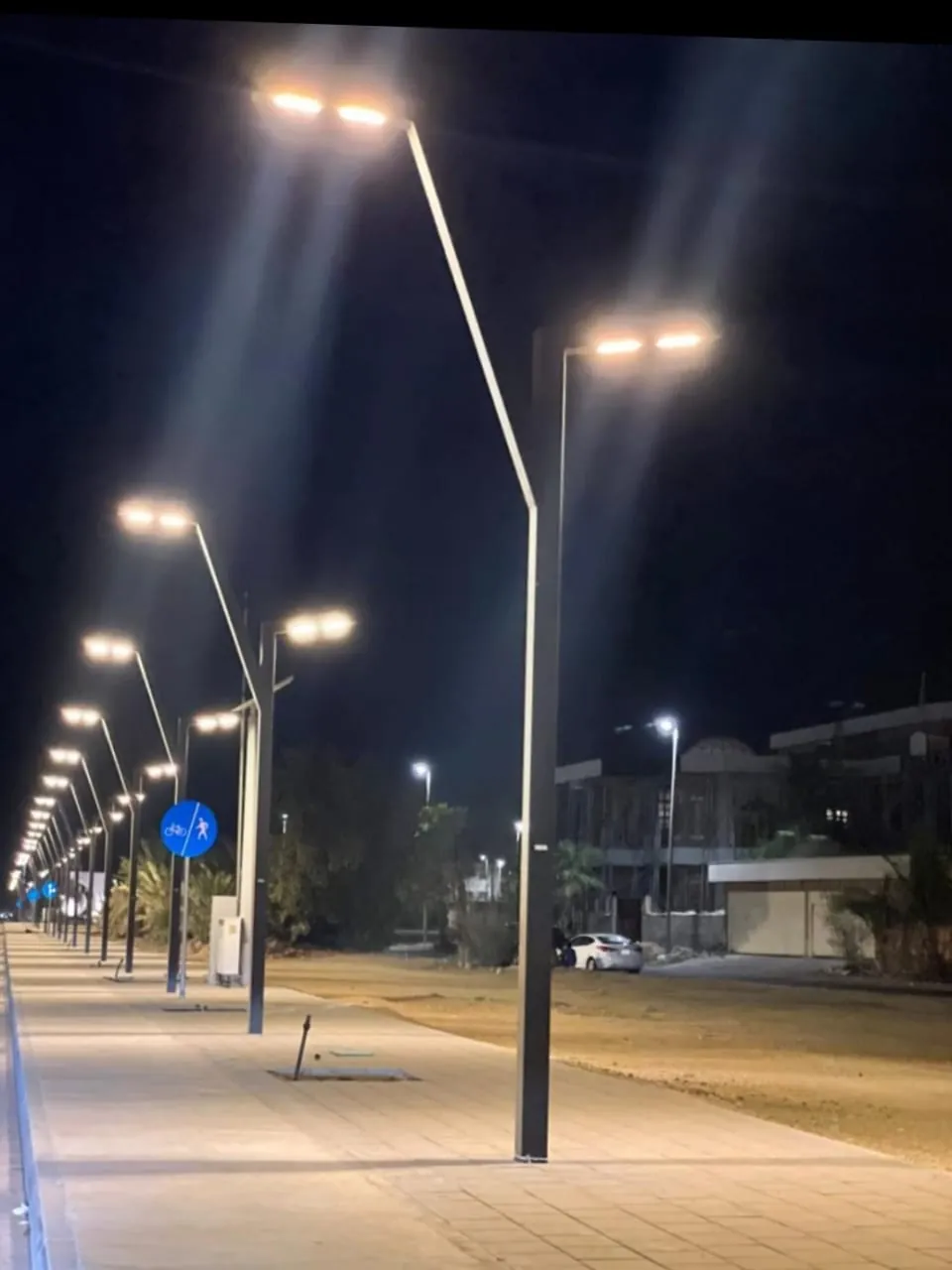
Distribution arrangements follow the lot geometry: a single row on one edge suits narrow aisles and lots; opposite or staggered double rows suit wide aisles between two parking rows; and a regular grid suits large open courts. Poles are placed at the islands separating parking rows so they neither obstruct manoeuvring nor suffer repeated impact, and their positions are chosen so pedestrian routes are not left in the shadow of parked cars or the poles themselves.
For very large lots, high-mast lighting is an option worth studying, since a single pole lights a large area from a head of fixture crossarms, reducing the number of poles, foundations and cables. But this carries its own structural and maintenance conditions and should be compared with a mid-height pole arrangement for uniformity, glare and maintenance cost before adoption — exactly as this trade-off is settled in large infrastructure projects.
Uniformity and glare in parking areas
Glare in parking areas is a double problem: glare that strikes the driver moving between rows and hides a pedestrian or obstacle at a critical moment, and glare that strikes the pedestrian looking horizontally toward fixtures at eye level. It is controlled by selecting fixtures with good upper-light cut-off and low emission at viewing angles, by an optical distribution suited to the shape of the space, and by a mounting height that keeps the source out of the moving viewer's line of sight. The rule is that raising power to cover a dark patch often increases glare and breaks uniformity rather than solving the problem.
Uniformity in a lot is measured across the driving and walking surface together and is directly affected by the relationship between pole height, pole spacing and the fixture's optical distribution. Excessive spacing leaves dark patches between parking rows and in lot corners; very tight spacing wastes poles and energy. The solution is a calculated balance, via photometric calculation, that chooses height, distribution and spacing together so the minimum uniformity is met without excess poles or power.
A factor specific to parking is the parked cars themselves: they are bodies that block light and cast moving shadows that change as the lot fills, producing dark patches that did not appear in a calculation over an empty lot. A full lot at night is a different scene from the empty lot the design is usually calculated over, and each car is a wall that blocks the light coming from behind it, darkening what lies in front. The design therefore favours, where possible, a distribution that brings light from more than one direction, and tests uniformity with cars present rather than over a bare surface — especially in pedestrian routes between rows where safety is at stake.
Multi-arm poles and fixtures
The multi-arm pole is the usual solution for wide lots because it carries two or more fixtures directing light in two or more directions from a single point, covering two opposing parking rows or lighting a circulation aisle between rows with better uniformity and fewer poles and foundations. Arms are made at angles and lengths suited to the width of the aisle to be covered, and their number (two, three, four) is chosen by lot geometry, not arbitrarily. This arrangement lowers foundation and cable cost compared with many single poles.
Selecting the fixture itself is a decision independent of the pole, since the pole carries the lighting and does not light. The fixture is chosen by its power, an optical distribution suited to the lot shape (wide distribution for courts, narrower and longer for aisles), colour temperature, ingress protection (IP) and impact rating (IK), efficacy (lumens per watt) and compatibility with the control system. These criteria are detailed in the street-light fixture selection guide, whose principles apply to parking with a difference in distribution and level.
Tilt angle matters when mounting fixtures on arms: excessive tilt increases coverage but raises glare and light spill, while zero tilt (fixture horizontal) reduces glare and upward spill but may shorten reach. This angle is settled by photometric calculation for each arrangement, and in commercial lots near housing or frontages it is generally preferable to keep upward emission low out of respect for neighbours and to reduce skyglow.
Integration with surveillance cameras, control and energy efficiency
Parking and commercial complexes are surveillance environments by nature, so security cameras are integrated with the lighting system from the design stage, not afterwards. A dedicated camera pole may be allocated, or the camera may be mounted on a multi-arm lighting pole if the section can carry the load and vibration and allows cable routing. What matters is that the level, uniformity and recognition of faces and plates are sufficient to produce a usable image; a camera over a dark or glare-filled scene is worthless. This lighting-and-surveillance integration is detailed in the camera and surveillance poles guide.
Energy efficiency is central in commercial lots because they operate long hours over wide areas, so any saving in power per pole multiplies across the count. High-efficacy LED (lumens per watt) is the basis, augmented by time-based and smart control: dimming after closing hours, motion-sensing in low-traffic side aisles, and photocell control to switch on and off by daylight. These tools cut the bill and extend fixture life without compromising safety at peak hours.
Note that night-time dimming has a limit set by safety and security: the light of pedestrian routes, entrances and camera points is not dimmed below the level that recognises faces and serves surveillance. Control scenarios are therefore programmed by zones, not a single switch: zones that stay at their security level, and zones dimmed in quiet hours, while the minimum uniformity is met in every scenario. This gradation is what reconciles energy efficiency with security without sacrificing either.
The decorative dimension at commercial frontages and durability under heavy use
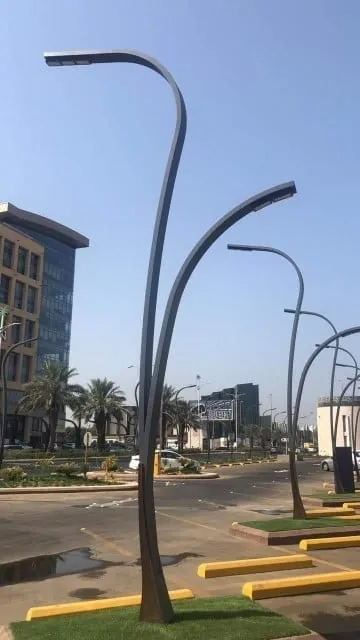
A commercial frontage wants more than clear vision; it wants a visual presence that attracts and anchors the identity of the place at night. Here decorative poles enter as an element that shapes the character of the frontage, entrances and front aisles through their forms and colour finishes, harmonising with the complex's character and brand rather than a purely functional pole. The decision here is visual and identity-driven as well as photometric, detailed by the decorative-pole design guide, provided photometric performance and uniformity remain governed by calculation, not form alone.
Even so, the rear lot and wide parking courts remain the domain of the functional multi-arm pole, so a single project blends two styles: decorative at the frontage and entrances, functional in the depth of the lot. A careful blend of the two achieves identity and efficiency together, and requires unifying colour temperature and overall appearance between the styles so the project does not look visually disjointed when moving from frontage to lot depth. Note that the warm temperature best suited to the frontage may not alone be enough to recognise faces in the lot depth, so identity effect and security performance are balanced rather than one favoured over the other.
Durability is an essential consideration under heavy commercial use: parking poles are exposed to impact from vehicles and carts, to dust, humidity and year-round sun, and to long operating hours. They are therefore hot-dip galvanised to ISO 1461 / ASTM A123 (with a coating thickness usually in the 70-to-120-micron range depending on section, the minimum confirmed against the standard) and then electrostatically powder-coated for UV resistance and colour stability. Pairing the two methods, and which comes first, is covered by the galvanizing-versus-powder-coating guide, and mounting bases account for likely impact on separating islands.
How to choose for your parking lot or commercial complex
Assemble the decision in this order: start by dividing the project into zones (frontage, entrances and gates, circulation aisles, parking rows, pedestrian routes, camera areas) and set each a target lux and uniformity within EN 12464-2 and CIE guidance; then choose the appropriate height within the 4-to-10-metre range and the distribution arrangement by lot geometry; then specify the pole (multi-arm for function, decorative for identity) and the fixture by distribution, colour temperature and ingress rating; then integrate cameras, control and energy efficiency; then choose a finish durable for heavy use; and finally verify spacings and uniformity by photometric calculation with cars present, not over a bare surface.
The governing standards remain the same in essence: EN 12464-2 with CIE guidance frames the levels and uniformity for outdoor work and traffic areas, IEC/EN 60598 governs fixture safety and IP/IK ratings, and the pole is designed for wind loads to SBC 301, alongside the requirements of the owner — municipality, developer or complex owner. Figures are always verified by photometric and structural calculation, not estimation, and exact values are verified against the latest edition of each text with a qualified engineer.
At the Aktar factory in the Al-Sulai district of Riyadh we manufacture multi-arm parking poles, decorative poles for complex frontages and camera poles in heights from 0.5 to 16 metres (taller on request), hot-dip galvanised to ISO 1461 and electrostatically powder-coated, designed for wind loads to SBC 301 and conforming to SASO requirements, and we supply all regions of the Kingdom with a typical delivery of 7 to 14 business days. Among our commercial projects are the supply of 100 decorative poles 3 metres tall for a commercial project in Jeddah, and 55 decorative poles in 4-metre and 1-metre heights for a mall project in Dammam. Send us the site layout, the required light level and the camera locations, and our technical team will return a written recommendation combining pole type, height and distribution arrangement with fixture specification and spacings. The preliminary technical consultation is free and non-binding via WhatsApp.
Frequently asked questions
What is the appropriate light level for parking and commercial-area lighting?
Levels vary with traffic density within the framework of EN 12464-2 and CIE guidance. As indicative ranges: light-traffic parking around 5 to 10 lux, medium parking and circulation aisles around 10 to 20 lux, and entrances and payment points around 20 to 30 lux or more. The exact value is verified by photometric calculation against the latest edition of the text and the project class with a qualified engineer, and uniformity remains no less important than the level itself.
What is the typical height for parking lighting poles?
Parking and commercial-complex pole heights usually range from 4 to 10 metres. Lower heights (4 to 6 metres) suit small lots and areas near the frontage, while greater heights (8 to 10 metres) suit wide open lots because they cover a larger area with fewer poles. For very large lots high-mast lighting may be an option, after comparison with a mid-height pole arrangement for uniformity, glare and maintenance cost.
Can surveillance cameras be integrated with parking lighting poles?
Yes, and commercial lots are surveillance environments by nature, so the two are integrated from the design stage. A dedicated camera pole may be allocated, or the camera mounted on a multi-arm lighting pole if the section can carry the load and vibration and allows cable routing. What matters is that the level, uniformity and recognition of faces and plates are sufficient to produce a usable image, since a camera over a dark or glare-filled scene is worthless.
How is energy efficiency balanced with security in commercial-complex lighting?
With high-efficacy LED as the basis, then smart and time-based control: dimming after closing hours, motion sensing in side aisles, and photocell control. But dimming has a safety limit, so pedestrian routes, entrances and camera points are not dimmed below the face-recognition level. Control scenarios are therefore programmed by zones, not a single switch, while the minimum uniformity is met in every scenario.