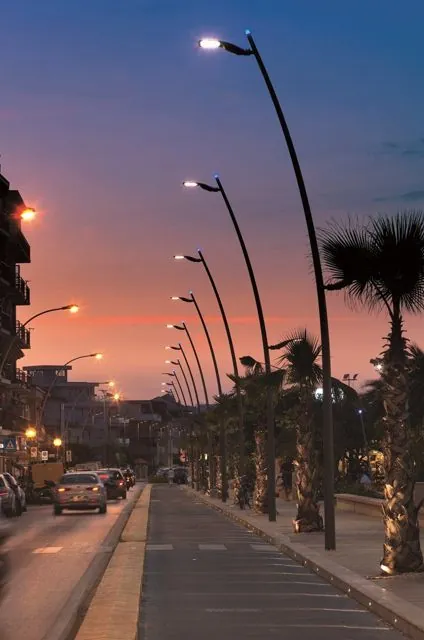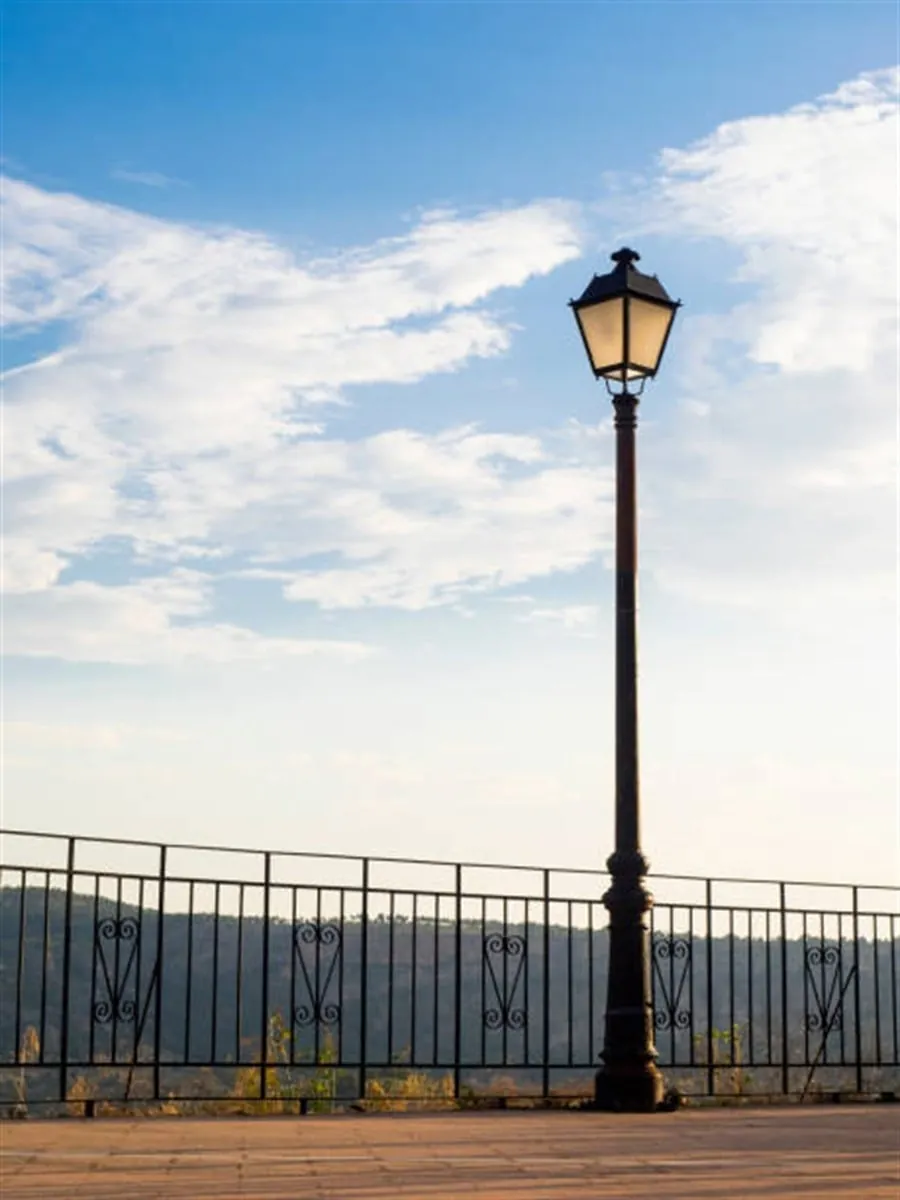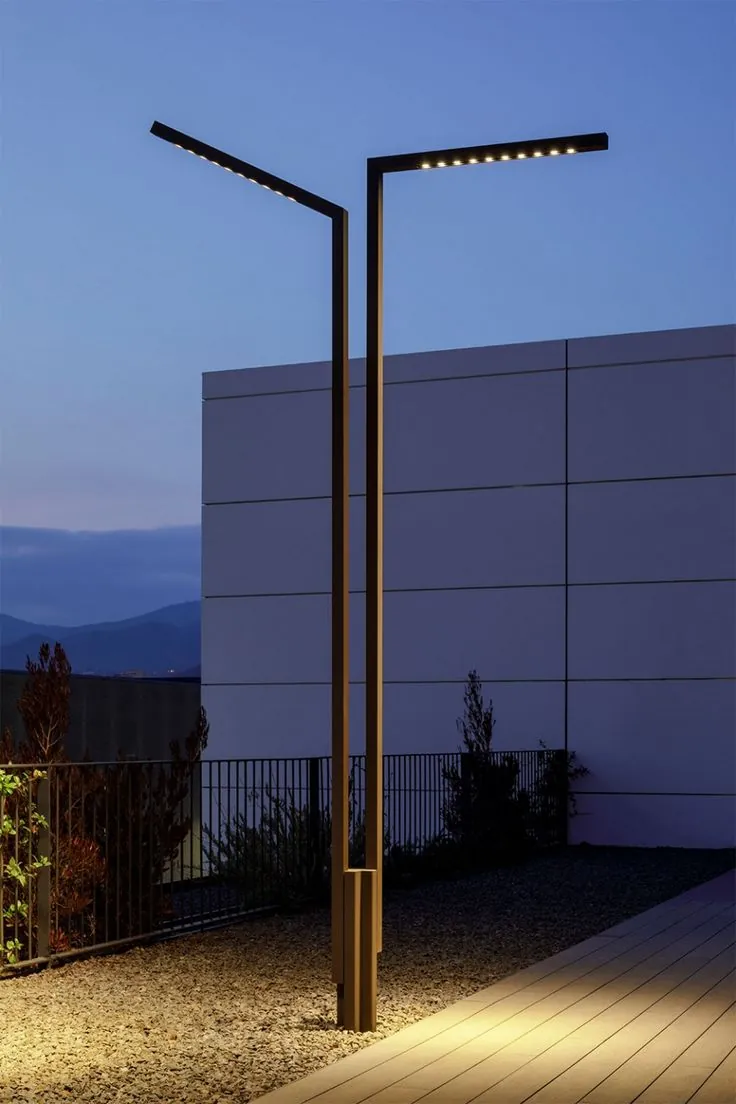
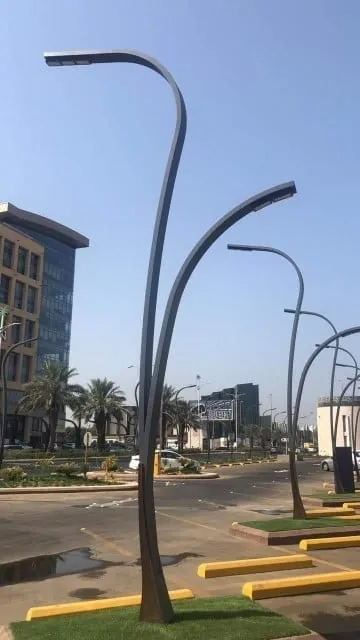
Why the fixture deserves a decision of its own, separate from the pole
The pole carries the lighting, but it does not light. What lights is the luminaire — the fixture mounted at the pole head — and it has a technical specification entirely separate from the pole's type, height, and finish. Many quotes are reduced to a wattage figure, yet wattage alone tells you neither how much light actually reaches the road surface nor how it spreads across it.
This guide deals with the fixture alone: the LED engine, luminous efficacy, colour temperature, optical distribution, electrical protection, and control systems. Choosing the pole family is the subject of our types-of-lighting-poles guide, height is covered in the pole-height guide, and the structural tender specifications are covered in the SASO and IEC specs guide.
The practical rule: the luminaire spec is derived from the road's lighting target, not from a commercial label. When the spec is right, the suitable pole and its spacing follow; the reverse is costly — the wrong fixture on a sound pole gives an uneven, glaring road.
Why LED replaced sodium and metal-halide
LED fixtures displaced High Pressure Sodium (HPS) and Metal-Halide (MH) sources from road projects for engineering, not marketing, reasons. Efficacy first: a good LED fixture today delivers roughly 140 to 180 lumens per watt at the whole-luminaire level, versus about 60 to 100 for sodium and 70 to 90 for metal-halide. In practice a roughly 100 W LED fixture can replace a 250 W sodium head, cutting connected load and consumption by 50 to 70% in most cases.
Then life and stability: LED rated life is typically 50,000 to 100,000 hours to L70/L80 — roughly 10 to 20 years — versus 15,000 to 25,000 hours for sodium and 8,000 to 15,000 for metal-halide. More importantly, an LED usually maintains over 90% of its output across its life, while sodium and metal-halide can lose 30 to 50% — and this is the heart of the difference in the replacement and maintenance cycle.
Finally quality and maintenance: an LED has no fragile arc tube, tolerates vibration and weather, switches and dims instantly without a warm-up period, and gives better colour rendering (CRI commonly 70 to 80+ versus about 20 to 30 for yellow sodium). The only trade-off is a higher purchase cost, and a more concentrated, bluer light that can raise glare if the distribution or colour temperature is chosen poorly.
Lumens and efficacy before watts — and why wattage is derived from the road class
Wattage is the energy consumed, lumens are the light produced, and efficacy (lumens per watt) is the bridge between them. That is why the spec should be written on the whole-luminaire efficacy, not on the bare-chip efficacy: chip datasheet figures are always higher (a theoretical ceiling near 230 lm/W), but lens, driver, thermal, and maintenance-factor losses reduce what actually arrives. The regulatory efficacy floor in the Kingdom is set by SASO 2927 (see the final section).
And wattage itself is an output of the photometric design, not an input: it is set by the road class (a lux target, or luminance for the higher classes), the road width, the mounting height, the spacing, then the luminaire's efficacy and distribution. The wider the road, the taller the pole, or the greater the spacing, the higher the required wattage.
As indicative ranges — always verified with a photometric calculation (DIALux or AGi32) against the governing class: residential roads around 20 to 70 W and 2,500 to 8,000 lm with looser uniformity; collector roads around 80 to 150 W and 10,000 to 20,000 lm; main and highway roads around 150 to 400 W and 20,000 to 30,000+ lm with the tightest uniformity. As a common example, an 8 m residential pole at 80 to 100 W is spaced roughly 25 to 35 metres apart depending on the photometric result.
Colour temperature (CCT) — between visibility and light pollution
Colour temperature is measured in kelvin (K) and is a spec decision, not mere taste. For residential, heritage, and sensitive areas, warm light around 3000K or lower is recommended: the American Medical Association's 2016 recommendation and dark-sky guidance (IDA/DarkSky) both favour ≤3000K — and warmer amber in protected zones — to limit skyglow, glare, and the ecological impact of blue light.
For main and arterial roads, neutral light around 4000K is usually recommended as a balance point: some research (such as that cited by IPWEA and the work of Gibbons) reports that whiter light can lengthen the driver's hazard-recognition distance. Very cool light above 5000K is discouraged in residential and sensitive areas because its high blue content increases skyglow and worsens glare, and many ordinances around the world cap new municipal lighting at 3000K.
The general principle: pick the lowest colour temperature that still meets the visibility and safety need of the road class, then control blue content and glare through the optic and shielding. In decorative projects colour temperature remains a question of visual atmosphere, covered in the decorative-pole-design guide, whereas here it is a road photometric spec decision.
Optical distribution — why the pattern matters more than the lumen number
On roads, the controlled distribution pattern matters more than raw lumens, because uniformity, glare, and how much light actually lands on the carriageway (versus what is wasted off it) are all governed by the optic, not the lumen count. The lateral patterns are classified per IES relative to the mounting height.
Type II has a relatively narrow lateral throw, suited to narrow roads and paths. Type III is the most common workhorse for general streets, collector roads, and two-to-three-lane roads. Type IV throws its light predominantly forward toward one side, used at road edges, building perimeters, and parking areas. Type V is symmetric 360 degrees, for intersections and open plazas rather than the usual roadside pole.
The practical rule: match the distribution to the road width and the pole's setback from the edge before you raise the lumens. A bright fixture with the wrong distribution gives a patchy, glaring road, while the right distribution at fewer lumens gives better uniformity and less glare. Sports-court lighting has a different distribution and aiming logic, covered separately in the sports-court-lighting guide.
Protection against dust, impact, and surges — critical for the Kingdom's grid and climate
Ingress rating (IP): specify IP65 as a minimum, with IP66 the road norm for the optical and driver compartment — that is, dust-tight and resistant to powerful water jets. This is essential against the dust, sand, and washing of the Kingdom's climate.
Impact rating (IK): specify IK08 as a minimum, with IK09 and IK10 available for resistance to vandalism and debris on the lens and housing.
Surge protection (SPD): the Saudi grid environment and its switching and lightning events make a surge protective device a necessity, not an option. Specify 10 kV as a baseline and 20 kV for exposed runs and highways, and require the device to tolerate an in-fixture temperature near 80°C. The protection level and the device's test class are defined against the recognised surge standards (IEC 61643 and ANSI C136.2), not by a commercial figure alone.
A missing or under-rated surge device is among the leading causes of premature LED-driver death in the region. These requirements are not to be confused with the pole's structural earthing requirements, which are covered in the tender-specs guide.
Control systems and glare control
Control systems begin with a photocell on a 3-pin NEMA socket for dusk-to-dawn on/off switching. The 7-pin ANSI/NEMA socket enables dimming and controllable nodes. Dimming via 0–10 V, 1–10 V, PWM, or DALI drivers enables energy savings and adaptive output.
Dimming in low-traffic hours (part-night or midnight dimming) steps the output down during quiet periods per the adaptive-class concepts of CIE 115 and EN 13201, saving energy while still meeting the lower class required at night. For smart corridors, a Central Management System (CMS) is added via NEMA/Zhaga nodes with cellular or RF connectivity for per-pole monitoring, fault reporting, scheduling, and metering.
As for glare on roads, the correct metric is Threshold Increment (TI), not UGR — the latter is fundamentally an indoor metric. EN 13201 and CIE practice target TI ≤ 10% on higher-speed roads, allowing a higher value (around 15%) on roads with lower design speeds. Glare is controlled through the correct optic, full-cutoff or flat-glass housings that limit uplight, appropriate mounting height, shielding, and choosing the lowest adequate colour temperature — which also serve dark-sky goals.
How to choose the spec — and the governing standards
Assemble the decision in this order: start from the road class and the lux or luminance target, which set the lumens and watts; then pick the optical distribution that matches the road width and the pole's setback; then the colour temperature (around 3000K for residential, around 4000K for arterial); then specify protection — IP66, IK08+, and a 10 to 20 kV surge device; then the appropriate control and dimming systems; and finally verify glare control against the TI value.
On standards: SASO 2927:2019 (energy efficiency, functionality, and labelling requirements for lighting products — Part 3: street lighting) is mandatory in the Kingdom since September 2020, classifies road lighting into the M (motorised), C (conflict areas and intersections), and P (pedestrian) classes, and sets minimum efficacy floors, with conformity verified through the SABER platform — and the exact numeric efficacy values should be confirmed against the latest edition of the text. IEC/EN 60598 (60598-1 general and 60598-2-3 for road luminaires) governs luminaire safety and underpins SABER acceptance via CB reports. CIE 115 and EN 13201 frame the class selection and the lux, uniformity, and TI criteria, alongside the local project requirements of the Ministry of Municipal and Rural Affairs and Housing.
At the Aktar factory we manufacture the metal structure for poles of every type, and match the lighting system to each project: we select and source the suitable luminaire spec to meet the target lux and distribution, and pair it with the right pole, height, and spacing. Send us the application type, the site, and the required illumination level, and our engineering team will return a written recommendation pairing the matched luminaire spec with the right pole. The consultation is free and non-binding.
Frequently asked questions
What luminous efficacy (lm/W) should a road luminaire be specified at?
Specify efficacy at the complete luminaire level, not the bare LED chip; good LED road luminaires today deliver roughly 140 to 180 lumens per watt at the fixture after lens, driver, and thermal losses. The regulatory minimum efficacy floor in Saudi Arabia is set by SASO 2927 for road lighting, with conformity verified through the SABER platform. The exact numeric figure should always be confirmed against the latest text of the standard and the governing road class.
What light colour temperature (CCT) is best for street lighting — 3000K or 4000K?
The rule is to choose the lowest CCT that still meets the visibility and safety needs of the class. Residential, heritage, and sensitive areas lean toward warm light around 3000K or lower, in line with dark-sky guidance to limit sky glow and glare. Main and arterial roads are typically recommended at neutral light around 4000K, while very cool light above 5000K is discouraged in residential areas because of its high blue content.
Which optical distribution pattern (Type II/III/IV/V) suits my street?
Lateral patterns are classified per IES relative to mounting height, road width, and pole position. Type II has a relatively narrow throw for narrow roads and pathways, Type III is the most common for general streets and collector roads, Type IV is forward-throw dominant for edges and car parks, and Type V is 360-degree symmetric for intersections and open squares. Match the distribution to road width before increasing lumens, since a wrong pattern produces a patchy, glaring road no matter how high the lumen output.
What protection ratings (IP, IK, and SPD surge protection) are required for road luminaires in Saudi Arabia?
Specify IP66 as the standard for roads on the optics and driver compartment (dust-tight and resistant to powerful water jets), and IK08 as a minimum impact rating with IK09/IK10 available. Because of lightning and switching events on the Saudi grid, specify a 10 kV surge protector as a baseline and 20 kV for exposed routes and highways, per IEC 61643 and ANSI C136.2. A missing or under-rated surge protector is one of the leading causes of premature LED driver failure in the region.