Why the coastal environment is a stand-alone protection decision
Choosing corrosion-resistant lighting poles for coastal areas is not a simple extension of an inland pole specification; it is a self-contained engineering decision that starts from diagnosing the environment rather than from the product. In cities such as Jazan and Abu Arish on the Red Sea coast, or Qatif, Jubail, and Ras Tanura on the Gulf coast, the metal surface faces a combination of three factors that rarely coincide inland: high relative humidity for most of the year, airborne chloride salts (sea spray), and daily wetting-and-drying cycles that accelerate the electrochemical reaction. This combination is what turns an acceptable inland design life into early corrosion on the coast.
Chlorides in particular are the decisive factor; they penetrate surface protection layers, keep the surface wet even without rain, and weaken the zinc protective layer faster than in dry inland regions. Because the pole stands outdoors around the clock, any weakness in the finish or any detail that traps water is magnified over time. The coastal protection decision therefore rests on a simple principle: we engineer the system to resist the harshest environment expected at the site, not its average.
This guide addresses the coastal angle specifically — the corrosivity category, higher galvanizing thickness, duplex systems, fasteners, and design and maintenance details — and it complements rather than repeats the galvanizing-versus-powder-coating guide that explains the general difference between the two systems. It also intersects with the foundations-and-installation guide on water-entrapment details at the base, and with the maintenance-and-lifespan guide on the periodic inspection programme. The figures here are approximate frameworks whose exact values must be verified against the latest edition of the standard, the project category, and a qualified engineer.
Corrosivity classification per ISO 9223 — from C3 to marine CX
The first correct engineering step is to classify the site within the corrosivity categories of ISO 9223, which rank environmental severity in categories roughly from C1 (very dry indoor) to C5 (severe marine/industrial) and then the CX category for extreme marine and tropical environments. Dry inland regions of the Kingdom usually fall in low-to-medium categories, while the direct coastal strip in Jazan and the Eastern Province approaches the upper categories C5 and possibly CX right at the spray line, which completely changes the protection equation.
The importance of this classification is that it ties the decision to a measurable parameter instead of subjective judgement; the categories are defined through annual mass-loss rates of zinc and steel at the site, and the higher the category, the shorter the expected life for any given protection thickness. In practice, moving from a medium category to a high coastal category means a system that lasts twenty years inland may not reach half that on the coast unless protection thickness is increased or a second system is added on top.
The category is not chosen from the pole's distance to the sea alone, but from the interaction of distance with prevailing wind direction, terrain, local humidity, and any nearby industrial sources; two sites at the same distance from the shore may fall in different categories. It is therefore advisable to fix the target category in the specification document from the outset, as in the road-lighting specifications guide, so suppliers price on the same basis. The numeric boundaries between categories remain standard values to be verified against the latest edition of ISO 9223 and a qualified engineer according to actual site readings.
Higher-thickness hot-dip galvanizing per ISO 1461
The cornerstone of coastal protection is hot-dip galvanizing per ISO 1461, where the whole pole is immersed in a molten zinc bath so a metallurgically bonded alloy layer forms on the steel, providing cathodic protection rather than mere surface insulation. This electrochemical protection is what makes galvanizing the most suitable choice for humid, salty environments, because the zinc sacrifices itself to protect exposed steel at any scratch — unlike coating alone, which opens a path for rust beneath the layer at a deep scratch, as the galvanizing-versus-powder-coating guide explains.
On the coast a higher zinc thickness than the usual inland level is targeted, because the annual zinc consumption rate rises with the corrosivity category, and galvanizing life is roughly equal to zinc thickness divided by the annual consumption rate. The minimum thickness in ISO 1461 is defined as a function of the galvanized steel wall thickness, and it can be raised above the standard minimum by surface treatment or by selecting suitable steel composition, so the coastal pole is given an additional 'zinc reserve' that translates directly into longer service years.
Galvanizing quality is not judged by eye but by a documented certificate; zinc thickness is measured with a magnetic gauge at several points on the pole, the values are logged in the project file, and the surface is verified to be free of uncoated areas or excess drips. For coastal projects it is preferable to require this certificate for every batch, not a single sample. Thickness figures and consumption rates remain approximate standard values to be verified against the latest edition of ISO 1461 and ISO 9223, the site category, and a qualified engineer.
The Duplex system — galvanizing plus powder coating
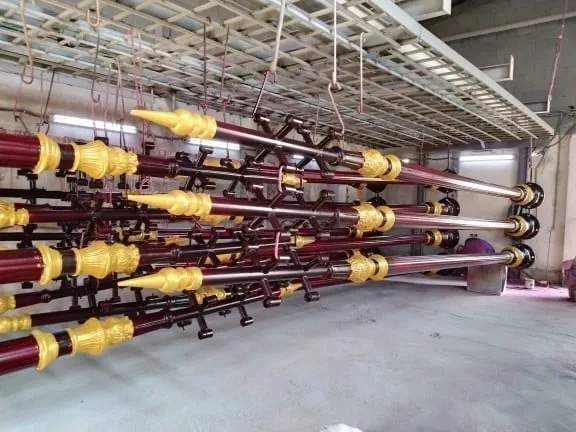
For upper coastal environments, the strongest practically recommended option is the duplex system: hot-dip galvanizing first, then electrostatic powder coating on top. The idea is that each layer protects the other; the outer coating slows the zinc's exposure to chlorides and humidity so it depletes slowly, while the zinc beneath provides backup cathodic protection if the coating is damaged by a scratch or impact. This integration makes the system most suitable for Jazan and Eastern Province sites near the sea spray.
The important effect of the duplex system is that it is not a mere sum of the two layers' lives but a multiplicative synergy well known in the corrosion-protection literature; the total life of a duplex system tends to exceed the sum of galvanizing alone and coating alone, because their joint presence slows the degradation mechanisms of both. The duplex system is therefore chosen for long-life projects where costly coastal maintenance is hard to repeat, despite its higher initial cost, which is recovered through fewer repair and replacement cycles, as the maintenance-and-lifespan guide shows.
The success of the duplex system depends on correct surface preparation between the layers; the zinc surface needs suitable treatment before coating so the coating adheres well and does not later delaminate, and UV-resistant coating resins are chosen to stabilize the color under the coastal sun. Beyond durability, the coating provides the color stability and aesthetic finish required, which suits decorative poles on the corniche and coastal walkways. The thicknesses of the two layers and the adhesion requirements are to be verified against product specifications, the relevant standards, and a qualified engineer.
Fasteners and accessories — the hidden weak link
The first signs of coastal corrosion often concentrate not in the pole body but in the fasteners and small parts: anchor bolts, nuts, washers, the maintenance door hinges and lock. If these parts are of unprotected steel or a different metal, they corrode faster and leave traces that spread to their surroundings. Fasteners in a coastal project are therefore treated with the same care as the pole itself, not as secondary items.
The two usual options are hot-dip galvanized steel fasteners, or stainless steel fasteners of a grade suitable for the marine environment. Attention must be paid to galvanic corrosion, which arises when two dissimilar metals contact in the presence of salty moisture, causing the less noble of them to corrode quickly; the metals must therefore be compatible or isolated, and stainless fasteners should not be mixed with galvanized surfaces without considering this effect. Anchor bolts should comply with a suitable specification such as ASTM F1554 with site-appropriate protection.
The maintenance-door details and the cable entry opening deserve special attention on the coast, because they are potential paths for moisture to enter the pole interior where the wiring and connections are. A resistant door frame and a galvanized or stainless lock are chosen, cut edges are protected by re-treatment, and a suitable protection rating is observed for the internal electrical connections per IEC 60529, as this integrates with the earthing-and-safety guide. Stainless steel grades and fastener specifications remain values to be verified against the relevant standards, the corrosivity category, and a qualified engineer.
Design details that prevent water entrapment
More than half of coastal corrosion problems originate in design rather than material; any detail that traps water or prevents its drainage becomes a permanent corrosion focus. The core rule is to design the pole to 'dry out': bottom drainage at the base, avoidance of closed pockets where water collects, and a slight slope on horizontal surfaces so water runs off rather than settles. These details cost almost nothing at the design stage, yet they multiply actual life on the coast.
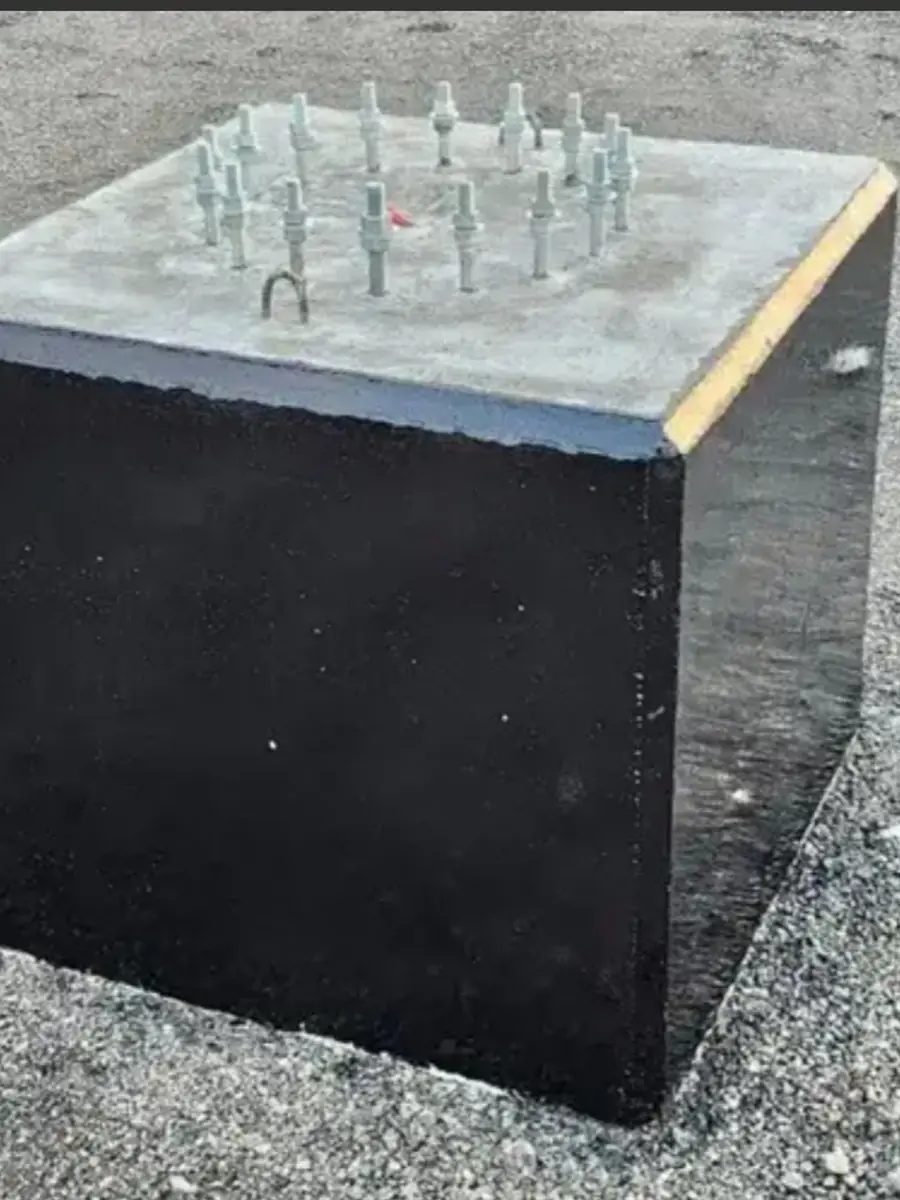
At the base region in particular the pole must not remain submerged in standing water or in damp backfill touching the steel; the base plate is therefore raised above the water-collection level, the gap between the plate and the concrete is designed to drain rather than retain, and the pole-to-foundation joint is treated to prevent moisture seeping inside. This treatment is part of integrating the pole with its foundation as the foundations-and-installation guide details, and it carries more weight in the coastal environment because any trapped moisture there is saturated with salts.
Likewise, galvanizing itself requires suitable vent and drain holes that allow molten zinc to enter and exit during immersion; these holes are functional first and prevent later liquid entrapment. Conical tubes closed at the ends are treated to prevent an internal damp pocket forming. Sound water-drainage design may be the cheapest way of all to extend coastal pole life, but its details are verified against the product guide, the relevant standards, and a qualified engineer according to the site.
Periodic maintenance in the coastal environment
No coastal protection system removes the need for a periodic maintenance programme, because the salty environment acts on surfaces around the clock. The simplest and most effective measure is periodic washing with fresh water to remove salts accumulated on the pole surface, especially in shaded areas not washed by rain, since removing chlorides directly slows the degradation rate. This measure integrates with the inspection programme described in the maintenance-and-lifespan guide.
The periodic round includes a visual inspection of the pole's protective layer to look for any surface rust, coating flaking, or scratches that reached the steel, with special focus on the fasteners, maintenance door, and base region where corrosion usually begins. Any scratch reaching the metal is treated early with a suitable spot repair before it widens, because early intervention on the coast is far cheaper than treating established corrosion.
The results of each round are documented in a record that tracks the poles' condition over time, revealing early any pole or site degrading faster than others and warranting intervention. Maintenance intervals on the coast are shorter than inland given the harsher environment, and the cost of these rounds should be counted within the project's total cost of ownership from the selection stage. The frequency of rounds remains a framework adjusted against the site's actual corrosivity category, the supplier's recommendation, and a qualified engineer.
Choosing the system by corrosivity category and location
The decision reduces to linking the corrosivity category and location on one side with the required protection level on the other. At coastal sites moderately distant from the sea, higher-than-usual galvanizing thickness per ISO 1461 with regular maintenance follow-up may suffice. But at sites near direct spray in C5 categories and approaching CX, the most suitable is a duplex system that combines the cathodic durability of galvanizing with the coating barrier and its color stability.
Because the required design life enters the equation, a municipal project intended for two decades of service on the coast deserves a stronger system than a short-lived temporary project, even if they share the same location. The practical rule is to choose the system on the basis of target life and environment category, not lowest purchase price, because the true cost of a weaker finish is paid later in maintenance and replacement within a few years — a logic repeated in the cost-factors guide.
Finally, the system decision is fixed in the specification document in measurable language: target corrosivity category, minimum zinc thickness, presence and type of top coating, fastener specification, and maintenance frequency. This clarity makes bids comparable on a single basis and prevents misleading comparison between unequal systems, as in the approach of the road-lighting specifications guide. The numeric boundaries between categories and systems remain standard values verified against the latest editions of the standards, site readings, and a qualified engineer.
Aktar's corrosion-resistant poles for coastal projects
At the Aktar factory in the Al-Sulai district of Riyadh, lighting poles are made to spec, which allows engineering the protection system according to the corrosivity category and location for each coastal project individually. Treatments include hot-dip galvanizing per ISO 1461 and electrostatic powder coating, with the option of the duplex system for harsher sites, wind-load design per SBC 301, and operation within the SASO framework. All regions of the Kingdom are covered with a typical delivery time of 7 to 14 business days.
Among the documented coastal projects, Aktar supplied 60 conical decorative poles 6 meters high with 60 insulated concrete bases for a project in Abu Arish in the Jazan region, with a finish suited to the coastal climate. This project embodies the guide's logic in practice: combining a conical decorative pole, an insulated concrete base, and a finish directed at the humid, salty coastal environment — which integrates with the foundations-and-installation guide on treating the base region.
Aktar's seven families cover street, decorative, garden, sports, laser-cut, walkway-and-parking, and bollard poles, together with concrete bases, in heights from 0.5 to 16 meters and higher on request, with a manufacturer warranty up to ten years per spec. For anyone planning a project on the Jazan or Eastern Province coast, the Aktar team offers a free, non-binding preliminary technical consultation via WhatsApp to help you fix the corrosivity category and the most suitable protection system before manufacturing.
Frequently asked questions
What makes lighting poles in coastal areas corrode faster than inland ones?
The coastal environment combines high humidity, airborne chloride salts (sea spray), and daily wetting-and-drying cycles, and these factors accelerate the electrochemical reaction and keep the surface wet even without rain. Chlorides in particular penetrate protection layers and consume zinc faster, so coastal poles need a stronger protection system than their inland counterparts.
Which corrosivity category suits coastal lighting poles in Jazan and the Eastern Province?
Sites are classified per ISO 9223 in categories from C1 to C5 and then CX, and the direct coastal strip in Jazan and the Eastern Province approaches the upper categories C5 and possibly CX near the spray line. The category is not chosen from distance to the sea alone but from its interaction with wind, humidity, and terrain, and the value is verified against the latest edition of the standard and a qualified engineer.
Is galvanizing alone enough on the coast, or is a Duplex system needed?
At sites moderately distant from the sea, higher-than-usual galvanizing thickness per ISO 1461 with regular maintenance may suffice. At sites near direct spray in C5 categories and approaching CX, the most suitable is a duplex system combining galvanizing with powder coating, since its total life tends to exceed the sum of the two layers' lives separately.
Which fasteners and details require attention on coastal poles?
Hot-dip galvanized steel fasteners or stainless steel of a suitable marine grade are used, while avoiding mixing two dissimilar metals to prevent galvanic corrosion. Details are also designed to prevent water entrapment: drainage at the base, a slope on horizontal surfaces, and treatment of the maintenance door and cable entry opening to prevent moisture ingress.