Why the foundation is as critical as the pole — sometimes more
Most project specifications detail the pole — its height, type, and finish — then reduce the foundation to a single line: "concrete base". But a pole does not stand on itself; it stands on its foundation, and that foundation is what transmits the vertical and horizontal loads and moments — the weight of the pole and fixture, wind pressure on the exposed area, and the overturning moment it produces — into the ground without tilt or uplift. A sound pole on a weak base tilts or overturns; the reverse rarely happens.
The danger of a foundation failure is that it does not show on installation day, but months later or after the first strong wind event. It begins as a slight tilt that grows with every load cycle, or as cracks around the foundation neck, and can end with a pole overturning onto a road or car park. And because repairing a wrongly executed foundation means demolishing it, re-pouring, and re-erecting, the true cost of the error multiplies against the cost of doing it right from the start.
The practical rule: the foundation is a structural element designed by calculation, not by habit. Just as a pole's height is derived from the lighting target — as in the pole-height guide — the foundation's size is derived from that same pole's loads: the taller the pole, the longer its arm, and the more fixtures it carries, the larger the foundation it needs. So this guide should be read alongside the pole-height guide and the SASO and IEC tender-specs guide.
Precast versus cast-in-place foundations
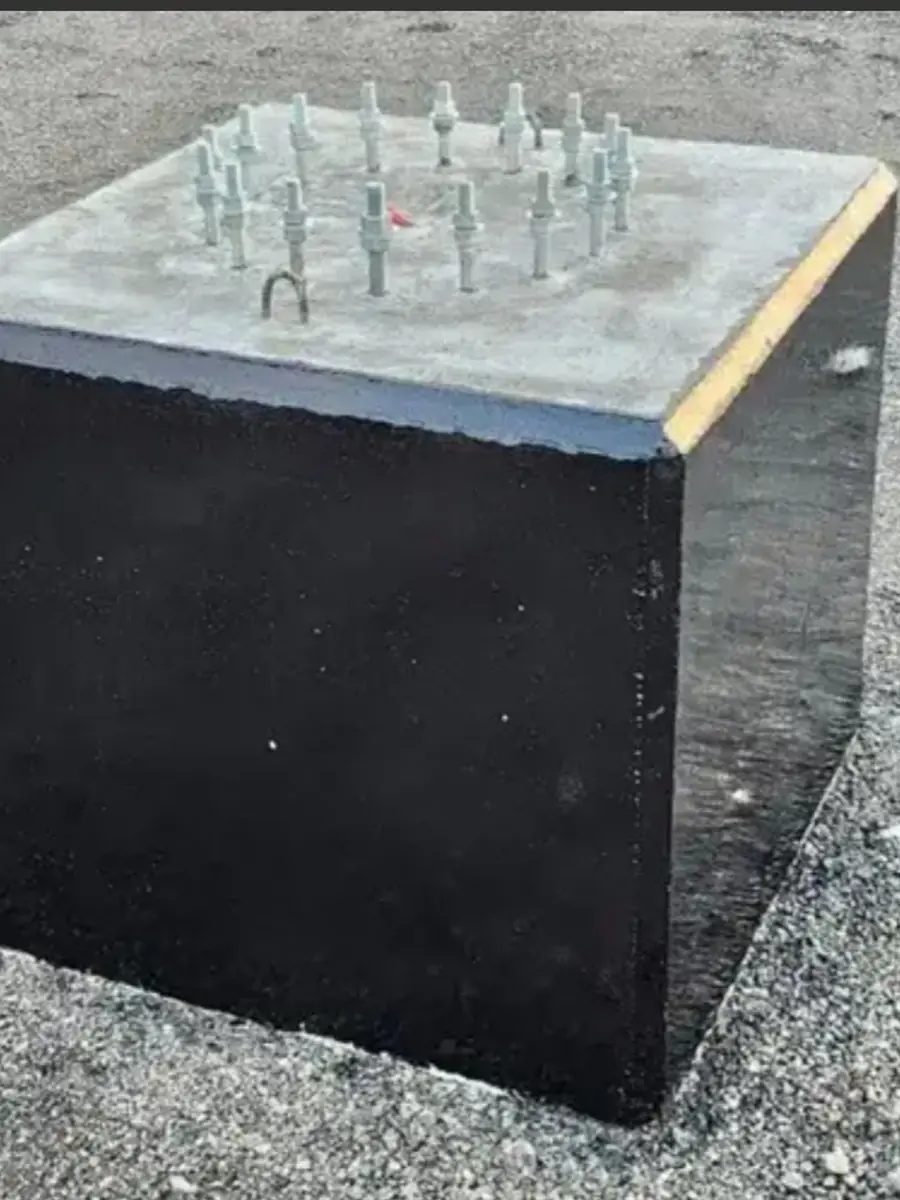
A foundation has two execution routes. Cast-in-place is poured into an excavation on site after the reinforcement cage, the anchor-bolt cage, and the cable conduits are set, then left to cure. Precast is a ready foundation cast at the factory in a steel form under controlled temperature and humidity, arriving on site complete with its bolts and conduits, and installed in an hour or two with no waiting for a cure.
The fundamental difference is in time and quality consistency. A cast-in-place foundation requires waiting for the concrete to cure — often days before erection — and cures in the open, exposed to heat, dust, and variable pouring conditions, which makes its actual strength more variable. A precast foundation, cured in a controlled environment, gives higher and more consistent strength, removes the on-site cure time from the project schedule, and allows installation in any weather or season.
The trade-off is practical, not absolute: precast suits repeated quantities, standard sizes, and tight schedules (roads, paths, car parks, and camera projects), where a ready base saves a week of waiting per location. Cast-in-place remains sensible for large, non-standard foundations, or where transporting a heavy ready base is difficult. In both cases the design — foundation size and reinforcement — governs, not the pouring method alone.
Sizing the foundation to wind and overturning loads per SBC 301
Foundation size is a calculated decision, not a number copied from a previous project. The governing load for lighting poles in the Kingdom is wind: wind pushes on the exposed area of the pole, arm, and fixture, producing an overturning moment at the pole base that grows with the height of its point of action. The foundation's job is to resist this moment with its own weight and the resistance of the surrounding soil, so that the pole neither overturns nor develops a net tension that uplifts its windward side.
Saudi Building Code SBC 301 (the loads and forces code, based on ASCE 7 with local modifications) sets the methodology for determining the design wind load and the load combinations. Among the most relevant for the foundation are the combinations that govern the overturning/uplift case — such as 0.9 dead + 1.0 wind — in which the foundation's resistance and weight must exceed the overturning moment with a safety margin, and no net tension should develop beneath the base in the case of a spread footing. The exact details are always verified against the latest edition of the text and with a structural engineer.
The principle that links pole to foundation: the taller the pole, the higher the wind moment arm; the longer the arm and the more fixtures it carries, the larger the exposed area; both enlarge the moment and therefore enlarge the foundation needed to resist it (in width, depth, and weight). So no single "one-size-fits-all" foundation is designed: a 3 m garden pole needs a small base, while a 12 m road pole with two arms needs a far larger one — not merely because it is heavier, but because the wind moment on it is much greater.
The base plate and the anchor-bolt assembly
The pole meets the foundation at the base plate welded to its foot, fixed to the concrete by anchor bolts cast into it. The common international standard for these bolts is ASTM F1554, which classifies them by yield strength into three grades — 36, 55, and 105 ksi — colour-coded (blue/yellow/red) for easy field identification. Grade 55 is the usual choice for lighting and traffic-signal poles. The bolts and nuts are hot-dip galvanised for corrosion resistance, consistent with the logic of protecting the pole itself.
The bolts are arranged on a "bolt circle" whose diameter and pattern match the base-plate holes exactly, and are held during the pour by a template that ensures correct positions, axes, and bolt verticality. A length of each bolt is left projecting above the concrete surface, long enough to accommodate the upper and lower nuts, the plate, and the galvanising. Any error in the diameter, pattern, or projection means a pole that will not seat on its base — among the most costly site mistakes.
For medium and large poles a double-nut assembly is used: lower leveling nuts beneath the plate and upper lock nuts above it. The leveling nuts allow the pole's verticality to be set precisely before the final tightening, after which the gap between the plate and the concrete is filled with non-shrink grout — once verticality and level are confirmed — to transmit the load evenly to the foundation. The bolts are tightened to the design torque in a cross sequence to distribute the load equally.
Concrete grade and cure time before erection
A foundation's strength is the strength of its reinforced concrete. The foundation is assigned a concrete grade (characteristic compressive strength) sufficient to resist the bolt loads and the bearing pressure beneath the plate, with reinforcement that resists the tension produced by the overturning moment. These values are drawn from the structural design and the project requirements, not from habit, and are documented with concrete cube test reports at delivery.
The standard reference for concrete strength is its 28-day strength, but a full 28 days is not required before erection: what governs is the concrete reaching a strength sufficient to resist the erection loads and bolt tension, a strength usually reached well before that depending on the mix and curing conditions. Premature erection — on concrete that has not yet gained its strength — is among the most dangerous mistakes, as it can crack the foundation neck around the bolts before the project carries any operational load.
Here the precast foundation's advantage shows: because it was cured at the factory and reached its strength before reaching site, the risk of open-air curing and premature erection disappears, and the waiting time is removed from the schedule. A cast-in-place foundation, by contrast, needs a protected curing period (wetting or evaporation-retarding covers) that resists the rapid drying of concrete in the Kingdom's hot climate — a factor often neglected, which weakens the surface and reduces its cohesion.
Cable conduits and earthing cast into the foundation
The foundation is not a solid concrete block; service routes that cannot be added later are cast into it. The most important is the cable conduit: pipes running from the pole's interior through the foundation to the underground supply network, set and fixed before the pour at positions and levels matching the pole's inspection door and the project network. Forgetting the conduit or misplacing it means breaking the foundation after the pour to pass the cable — a permanent injury.
Structural earthing is also cast in: an earth rod or strip connected to the pole's earthing point, protecting against electrical leakage and lightning. Sound earthing is a safety requirement, not a luxury, especially on exposed roads, and it complements the surge protection at fixture level covered in the SASO and IEC specs guide. Missing or inadequate earthing is a hidden hazard that does not appear until the first electrical fault or lightning strike.
So the conduit and earthing layout is planned before the pour, not after: their positions, levels, and angles are fixed on the drawing and set in the form. A precast foundation's advantage is that it arrives with its conduits and earthing integrated at the factory at controlled positions, reducing the site errors that often arise from manual work before the pour under time pressure.
The correct installation sequence, step by step
Installation begins with excavation to the depth and dimensions specified in the design, then preparing and compacting the base of the excavation. For cast-in-place: the reinforcement and the anchor-bolt cage with its template, the cable conduits, and the earthing are set, then the concrete is poured and vibrated to remove voids, and left for protected curing until it reaches sufficient strength. For precast: the ready foundation is lowered into the excavation, levelled, and backfilled around — eliminating cure time entirely.
Once the foundation is ready the pole is lifted and erected with lifting equipment matched to its height and weight; tall poles require a crane and a safe lifting plan, not mere manual lifting. The base plate is lowered onto the projecting bolts, and the pole's verticality is set precisely via the leveling nuts using a level or plumb, since any initial tilt is amplified visually and structurally with height.
The process is completed after verticality and level are confirmed: the upper nuts are tightened to the specified torque in a cross sequence, then the gap beneath the plate is filled with non-shrink grout to transmit the load evenly to the concrete, and verticality is re-checked after tightening. Finally the cables are passed through the conduit, the earthing is connected, and the inspection door is closed. This sequence — cured foundation, erection with suitable equipment, set verticality, tightening, grout, and earthing — is what separates a pole that lasts a decade from one that tilts in its first season.
Common installation mistakes — and how to avoid them
The most costly mistake is an under-sized foundation: a base designed for a shorter pole, or copied from another project without calculating this pole's loads, so it fails to resist the overturning moment and allows tilt or uplift under wind. Next is premature erection on concrete that has not reached its strength, which cracks the foundation neck around the bolts before any operational load. Both are avoided by adhering to the structural design and to the cure time before erection.
Then the precision errors: a tilted pole because verticality was not set with the leveling nuts; an error in the bolt circle or projection that prevents the plate from seating; neglecting the leveling grout beneath the plate so the load does not transmit evenly; and tightening the bolts to the wrong torque or in a non-cross order. All are avoided with a precise anchor-bolt template, a level at erection, and adherence to the torque and sequence specified in the design.
And the most dangerous because they are hidden: inadequate or missing earthing, a forgotten or misplaced cable conduit, and unprotected curing that lets the concrete dry too fast in the heat and weakens its surface. These do not show on handover day but later — at the first lightning strike, when a cable cannot be passed, or when the surface cracks. They are prevented by planning the conduits and earthing before the pour, protecting the cure, or by choosing a precast foundation that arrives with its conduits, earthing, and strength factory-controlled.
Aktar foundations and installation support
At the Aktar factory in Riyadh's Al-Sulai district, alongside poles in their seven families and heights from 0.5 to 16 metres, we manufacture precast concrete foundations in sizes ranging from 50×50×50 cm to 80×80×120 cm, arriving on site ready with their bolts and conduits to be installed without waiting for a cure. The foundations are supplied insulated and coated with a bitumen layer that protects the buried concrete against moisture and corrosion.
We match the foundation size to the pole it carries: we take the pole's height, arm length, fixture count, and location, and base the structural design for wind and overturning loads on the logic of Saudi Building Code SBC 301, recommending the appropriate size and reinforcement instead of a generic "one-size-fits-all" base. When needed we prepare engineer-stamped structural calculations for tenders, and galvanising-thickness reports per ASTM A123 for the anchor bolts and the pole, within a SASO conformity package.
At the Aktar factory we make the pole and its foundation together as one system, and support its installation so it sits level, earthed, and lasting. Send us the pole's height and type, the number of fixtures, and the project location, and our engineering team will return a written recommendation on the appropriate foundation size, its execution, and its installation sequence. The consultation is free and non-binding.
Frequently asked questions
What is the difference between a precast and a cast-in-place foundation?
A precast foundation is made at the factory in a form under controlled curing conditions, so it arrives on site ready with its bolts and conduits and is installed in an hour or two with no wait for a cure, at higher and more consistent strength. A cast-in-place foundation is poured into the excavation and cured in the open, requiring days of waiting before erection and giving more variable strength. In both cases the structural design governs, not the pouring method alone.
How long must the concrete cure before erecting the pole?
The standard reference for concrete strength is 28 days, but a full 28 days is not required; what governs is the concrete reaching a strength sufficient to resist the erection loads and bolt tension, usually reached well before that depending on the mix and curing conditions, and confirmed by the engineer and cube tests. Premature erection on concrete that has not gained its strength can crack the foundation neck. A precast foundation arrives factory-cured, eliminating the wait.
What standard governs lighting pole anchor bolts?
The common international standard is ASTM F1554, which classifies bolts by yield strength into grades 36, 55, and 105 ksi, with Grade 55 the usual choice for lighting and traffic-signal poles. The bolts are arranged on a bolt circle matching the base-plate holes, held by a template during the pour, hot-dip galvanised, and left with a sufficient projection to accommodate the nuts and the plate.
How is a lighting pole's foundation size determined?
By structural calculation, not by copying from a previous project. The governing load is wind, which creates an overturning moment that grows with the pole's height, arm length, and fixture count. The foundation is designed using the Saudi Building Code SBC 301 methodology so that its resistance and weight exceed the overturning moment with a safety margin, with no net tension developing beneath the base. So the foundation grows as the pole and its loads grow, and no single foundation suits all poles.