Why there is no fixed spacing between poles
The most frequently asked question in lighting projects is 'what is the spacing between poles?', and the correct engineering answer is that no single number suits every road. Spacing is not an input you choose in advance; it is the output of a lighting design that balances the required illuminance, the uniformity, the mounting height, and the luminaire distribution. When a number is copied from a previous project and forced onto a road of a different class and width, dark patches appear between poles or energy is wasted through an excessive count.
The spacing decision differs fundamentally from the height decision we covered in the guide on choosing pole height; height is a vertical dimension that sets the size of the light patch and its angle of incidence, whereas spacing is a horizontal dimension that sets how adjacent patches overlap to form a continuous lit surface. The two decisions are interlinked but are not the same thing, and treating one in isolation from the other produces an unbalanced design.
In this guide we address the horizontal planning and the lighting-level design: where spacing actually comes from, which inputs derive it, and how it interacts with height and the geometry of the road. As a rule throughout what follows: numbers are treated as indicative ranges, and the exact figure must be verified against the latest edition of the standard, the project class, and a qualified engineer before adoption.
Design inputs: road class, lighting level, and uniformity
Design starts from the functional classification of the road: motorway, primary arterial, collector road, local street, or pedestrian path. Each class has a target lighting level expressed either as surface illuminance in lux for roads with pedestrian movement, or as luminance in cd/m² for roads with a uniform asphalt surface and fast vehicular traffic. This target is the first variable governing pole density.
The second variable is uniformity, meaning that the lit surface should not be bright patches separated by dark zones. It is usually measured by the overall uniformity ratio Uo (minimum to average), by the longitudinal uniformity UI along the driving axis, and sometimes by the threshold increment TI to limit glare. The higher the uniformity the standard requires, the smaller the permitted spacing between poles, because the overlap between patches must be denser.
The third variable comprises the surface and environmental characteristics: asphalt reflectance, the presence of pedestrians and cyclists, expected night-time activity, and transition areas such as intersections, curves, and bridges. These factors raise or lower the target and impose local adjustment of spacing. Because the required lighting level is directly affected by the pole's luminaire, this decision integrates with what was covered in the guide on choosing street light fixtures.
Reference standards: EN 13201, CIE road classes, Saudi authority guidelines, and SASO 2927
The most widely used framework for road lighting design is the EN 13201 series together with its associated CIE recommendations; it divides roads into lighting classes (such as the M families for motorized roads, C for conflict areas such as intersections and roundabouts, and P for pedestrians), and links each class to a target luminance or illuminance level, uniformity values, and glare limits. This series does not state a particular spacing between poles; it defines the performance the lit surface must reach and leaves spacing as a variable to be solved for in order to achieve that performance. It is these classes that are later translated into pole spacing through photometric calculations, not memorized numbers carried between projects.
Locally, many Saudi projects adopt the requirements of the authority having jurisdiction — the municipalities (amanat and baladiyat) and the road authorities — alongside SASO references and what relates to them, such as SASO 2927 concerning road lighting. These references coincide in substance with the international frameworks, but they may define local road classes and specific target levels tailored to the Kingdom's conditions of heat, dust, and traffic. It is therefore wrong to assume that a level applied in one project or country applies automatically to another; the particular specification booklet of the owning authority must be consulted before deriving any spacing.
For the photometric and electrical requirements in detail and the role of SABER (Saber) in proving conformity, it is useful to refer to the guide on road lighting specifications SASO/IEC. Note that standards are updated by edition; reliance must be on the latest edition in force, and any level or class mentioned here is for framing only and must be verified against the standard adopted for the project, the road class, and a qualified engineer.
The spacing-to-mounting-height ratio
The most practical tool for estimating an initial spacing is its ratio to the mounting height (the Spacing-to-Height ratio). As a common indicative rule in road lighting, the spacing usually falls in the range of about three to four times the mounting height, so a pole with a ten-metre mounting height gives an estimated spacing of roughly thirty to forty metres as a starting point. This ratio is an approximate input for a preliminary check, not a final value, and it is confirmed numerically by photometric calculation and the road class.
The ratio is not fixed because it is affected by the luminaire distribution, its efficiency, its luminous flux, and the required lighting level; a luminaire with a wide distribution and higher flux may allow a larger ratio while maintaining uniformity, whereas high luminance levels or strict uniformity impose a smaller ratio. This is why the spacing decision interacts directly with the height decision: increasing the height widens the light patch and permits larger spacing, but it may reduce the surface illuminance, requiring a stronger luminaire or an adjustment in distribution.
A common error is to fix the spacing and then choose the height later, or vice versa, with each in isolation from the other, ending the design with either dark gaps or surplus poles. The correct approach is to treat them as an interlinked pair within a single photometric model that verifies the target, the uniformity, and the glare together, then to select the combination that achieves the performance with the fewest poles. This integration is a natural extension of what was covered in the guide on choosing pole height, where the height is half of the equation and the spacing is the other half, and neither holds without the other.
Mounting arrangements: single-side, opposite, and staggered
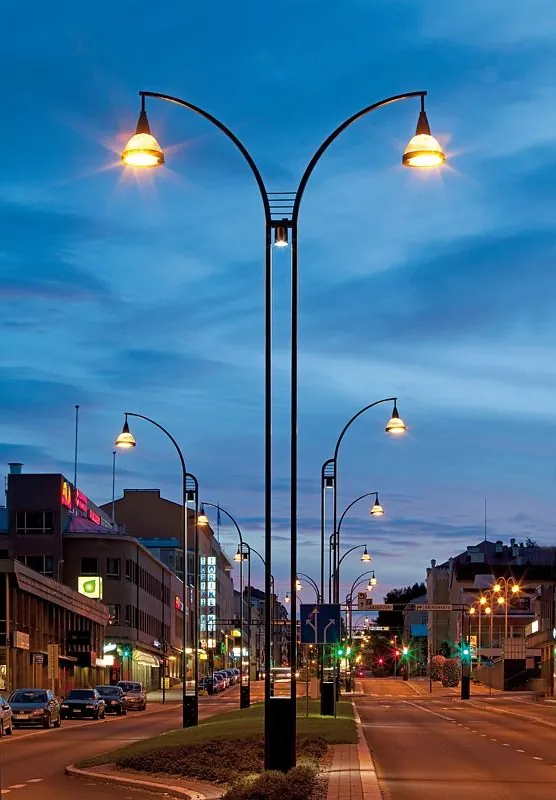
After the target and the ratio are set, the geometric arrangement of the poles across the road section follows, and it has three main patterns. The single-side arrangement on one side suits relatively narrow roads where the carriageway width does not exceed a certain limit compared with the mounting height; if the road widens, a drop in lighting appears on the opposite side, and lateral uniformity cannot be achieved with a single-side arrangement.
The opposite arrangement places two facing poles on either side of the road at the same section, and it suits wide roads and high luminance levels, since it doubles the lighting contribution and improves lateral uniformity. The staggered arrangement, meanwhile, distributes poles alternately between the two sides, balancing width coverage against reducing the pole count, but it requires precise spacing control so that ripples do not appear in the longitudinal uniformity along the driving axis.
Choosing the arrangement is not an aesthetic decision but a photometric and economic one: it determines the number of poles per kilometre and interacts with spacing, height, and distribution at once. On curves, intersections, and central islands, the regular rule is broken in favour of local coverage, where spacing is shortened or a pole is added to secure visibility of critical zones, in a manner that integrates with the recommendations of the guide on infrastructure project lighting.
The effect of luminaire distribution and lens type on spacing
The luminaire is not merely a light source but a distribution tool that determines the shape of the patch on the road surface, and it is the factor that translates height and spacing into actual uniformity. Luminaire distributions are usually classified according to standard patterns (such as the NEMA classification of Type II, Type III, and others) that describe the longitudinal and lateral extent of the patch. Choosing the distribution suited to the road width and the mounting height is what makes a given spacing achievable without dark spots.
Modern LED lenses allow precise shaping of the light beam, pushing the light longitudinally along the road axis to extend the spacing between poles while maintaining uniformity, or concentrating it laterally to cover side lanes. This control makes the luminaire distribution a design lever parallel to spacing itself; changing the lens may permit increased spacing without compromising the target, or may correct weak uniformity without adding poles.
Therefore, the choice of luminaire must not be separated from the planning of spacing; the photometric calculation is performed with the data of the actual luminaire (flux, distribution, colour temperature, efficiency), not with a general assumption. The details of choosing the luminaire and its distribution patterns were covered in the guide on choosing street light fixtures, and it is read alongside this guide as two faces of a single decision.
Overhang, tilt angle, glare, and light pollution
The arm overhang — the horizontal extent of the luminaire over the carriageway from the road edge — shifts the light patch towards the driving axis and improves lane coverage, but excessive overhang may waste light on far lanes and reduce illuminance at the kerb edge. The overhang is set in parallel with spacing and height within the same photometric model, not in isolation from them.
The tilt angle of the luminaire raises its front to extend the reach of the light longitudinally, apparently permitting larger spacing, but it is a trade-off: every increase in tilt raises glare and pushes light above the horizon, increasing light pollution and upward emission to the sky. So the tilt angle is kept at the minimum that achieves the target, and many modern LED designs operate at zero or near-zero tilt, relying on the lens instead of tilting the body.
Controlling glare and light pollution is not a luxury but a standard requirement; the glare limit (such as the TI index) and confining the light emission within the carriageway both enter directly into the acceptance of the design and into the driver's comfort and safety. The balanced solution combines a luminaire with a controlled distribution, a low tilt angle, a moderate overhang, and a spacing that achieves uniformity together — not the optimization of a single variable at the expense of the rest, since widening the spacing by excessive tilt, for example, gains on paper and loses in glare and upward emission. Every value of overhang, tilt, and glare limit is verified against the latest edition of the standard, the road class, and a qualified engineer before adoption.
Linking spacing to height in a single design model
The summary of the foregoing is that spacing is not calculated on its own, but within a photometric model that combines the road class, its target level, and the uniformity with the height, the luminaire distribution, the overhang, the tilt, and the arrangement. The photometric simulation is run with real data, then the spacing is adjusted until the required illuminance or luminance, the uniformity, and the glare limits are achieved at once. Changing any input calls for re-verification, since the decisions are interlinked, not independent.
The practical path starts by classifying the road and setting the target from the standard and the owner's specification booklet, then choosing a preliminary mounting height and luminaire distribution, then estimating an initial spacing via the spacing-to-height ratio, then verifying by photometric calculation and adjusting the arrangement, overhang, and tilt until consistency. This sequence shifts the question from 'what is the spacing?' to 'which spacing achieves the target with the fewest poles and the best uniformity?'.
This integration makes the spacing guide, the height and fixtures guides, and the road lighting specifications a single system read together. The governing rule at every step: numbers are indicative ranges for framing, and the final value is verified against the latest standard edition in force, the project class, and a qualified engineer before relying on the executable design.
How Aktar supports the spacing and lighting-design decision
At the Aktar factory in the Al-Sulai district of Riyadh, we manufacture seven pole families — street, decorative, garden, sports, laser-cut, walkway and parking, and bollard poles — in addition to concrete foundations, at heights from half a metre up to sixteen metres and higher on request. This range allows matching the pole to the mounting height and arrangement that the lighting design dictates for each road class, so that the choice of spacing rests on a pole designed for it, not the reverse.
Our poles are designed for wind loads per the Saudi Building Code SBC 301, treated with hot-dip galvanizing per ISO 1461 with electrostatic powder coating, within a SASO quality system, manufactured to specification for each project, and supplied to all regions of the Kingdom with a typical delivery period of seven to fourteen business days, with a manufacturer warranty of up to ten years per the specification. We have documented projects for government and private entities.
If you have a road section, its class, and the target lighting level, our technical team will be glad to provide a free, non-binding preliminary technical consultation on the mounting height, the arrangement, and the estimated spacing suitable for your luminaires — simply reach out via WhatsApp and send the road data so we can begin.
Frequently asked questions
What is the ideal spacing between lighting poles?
There is no fixed ideal spacing; the spacing between lighting poles is the output of a lighting design that links the road class, the required lighting level, and the uniformity to the mounting height and the luminaire distribution. As an indicative starting rule it often falls in the range of about three to four times the mounting height, then is confirmed by photometric calculation. The final value is verified against the standard, the road class, and a qualified engineer.
How is the spacing between poles actually derived?
Spacing is derived from three inputs: the road class and its target level in lux or cd/m², the required uniformity ratio, and the luminaire characteristics and mounting height. These inputs are translated through a photometric calculation and simulation; an initial spacing is estimated via the spacing-to-height ratio and then adjusted until the target, the uniformity, and the glare limits are achieved together — it is not copied as a number from another project.
Which standards govern lighting pole spacing in the Kingdom?
The broadest framework is the EN 13201 series and the CIE classes, which define road classes, their target levels, their uniformity, and glare limits, alongside the requirements of the Saudi authorities having jurisdiction and the SASO references and what relates to them, such as SASO 2927 for road lighting. One always refers to the latest edition in force, the owning authority's specification booklet, and the road class.
How does the spacing decision interact with pole height and mounting arrangement?
Spacing and height are an interlinked pair within a single photometric model; increasing the height widens the light patch and permits larger spacing but may reduce the surface illuminance. Likewise, the mounting arrangement — single-side, opposite, or staggered — determines the pole density and the lateral uniformity. These decisions are treated together, and every value is verified against the standard, the road class, and a qualified engineer.