What a High-Mast Lighting Tower Is and Why It Is a Standalone Decision
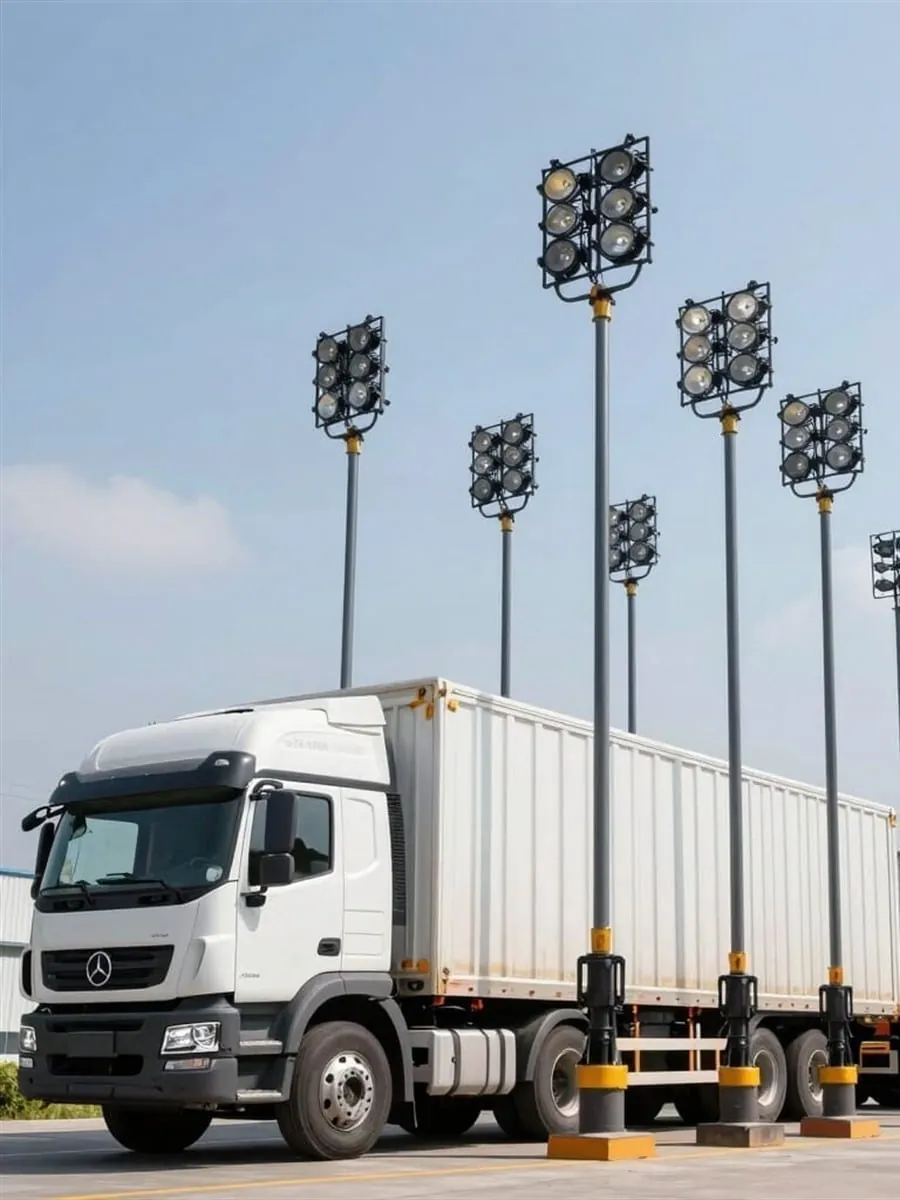
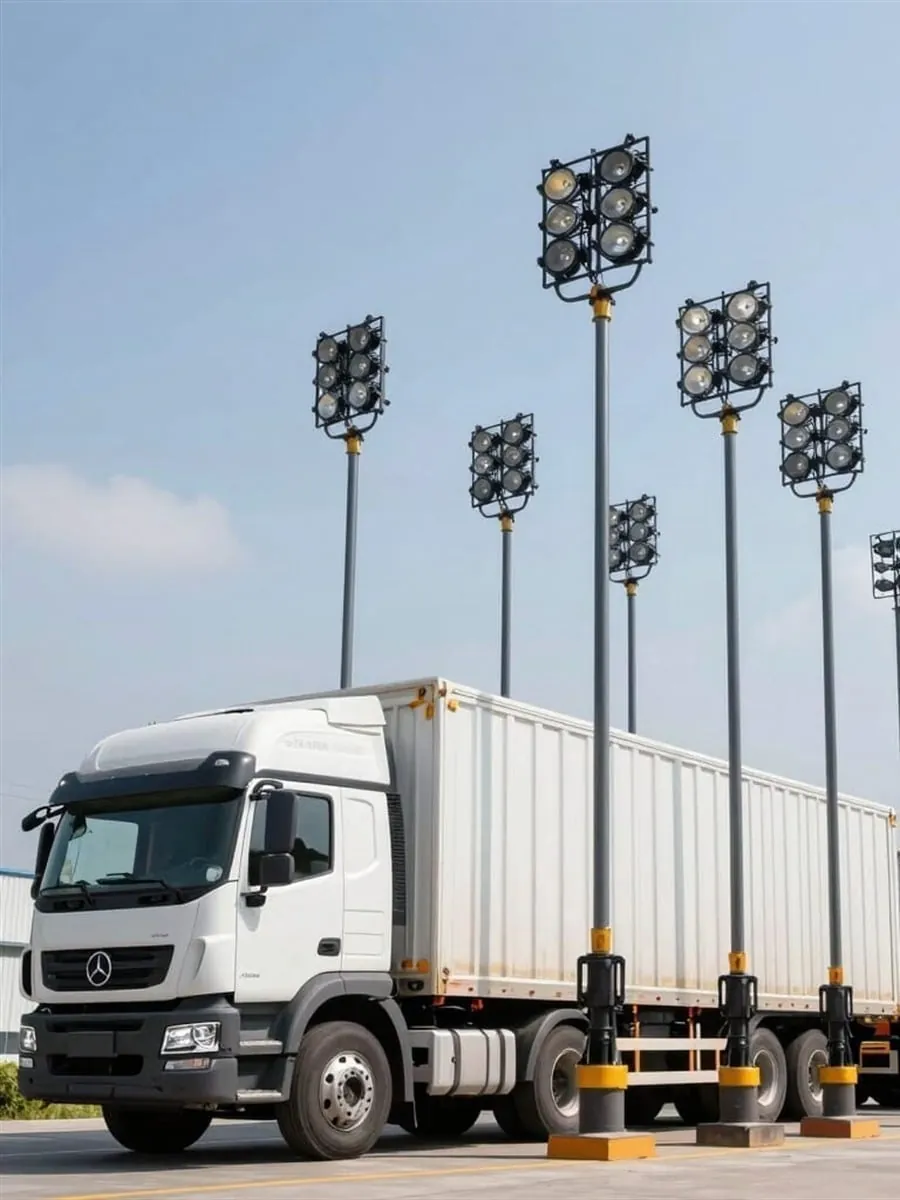
A high-mast lighting tower, known as a high mast, is a very large lighting pole that carries at its crown a ring or frame on which several powerful luminaires are mounted and aimed to cover a wide area from a single elevated point, instead of distributing many light points at conventional heights. High-mast heights typically fall in an approximate range between 15 and 40 m, far higher than a conventional street pole, placing them in a fundamentally different engineering and structural class. These numerical values are indicative and are to be confirmed against the project category and requirements and with a qualified engineer.
Choosing a high mast is a standalone decision because it changes the lighting philosophy itself: instead of lighting a road or yard with a row of closely spaced poles, one or a few widely spaced towers light it from a great height, changing with it the nature of coverage, the quantity of metal and concrete, the maintenance approach, and the glare calculations. A high mast must therefore not be treated as merely a taller pole, but as a complete design solution with its own logic and requirements distinct from distributed poles.
This guide addresses the application and engineering of high masts for highways, major interchanges, ports, industrial and logistics yards, and large car parks. It deliberately differs from the stadium mast engineering guide, which concerns sports-field lighting with its own photometric requirements, and from the sports-court lighting guide, which addresses the sports-illumination side. The sports mast and the high mast share the principle of great height and a top ring, but their purpose and photometric criteria differ, which is why they are separated here.
When High Masts Are Used: Typical Applications
The most suitable locations for high masts are wide open spaces that are difficult or costly to light with distributed poles. Foremost among these are major interchanges, large roundabouts, and highway junctions, where the driver needs a comprehensive view of multiple lanes at once and where erecting many poles among the islands and ramps is difficult and hazardous. One or two high-mast towers in a studied location cover an entire interchange with better uniformity than a forest of scattered poles.
Ports, industrial and logistics yards, and open storage areas are among the most fitting applications for high masts, because they are vast spaces requiring uniform general lighting for the movement of equipment, containers, and trucks, and because low poles within them obstruct maneuvering and are exposed to impact. High masts are likewise used in airport aprons and service areas, and in the large car parks of malls and major facilities, where they cover the parking area with a limited number of elevated light points instead of dozens of poles scattered among the cars.
The common denominator across these applications is the need to cover a large area with uniform general lighting from a few elevated points while reducing ground-level obstructions. When the priority is lighting a narrow longitudinal road rather than a wide yard, the balance returns in favor of distributed poles, as explained in the pole-spacing design guide, which addresses how distances between poles on roads are determined. Wide yards and interchanges, however, are par excellence the domain of the high mast.
High Mast Versus Distributed Poles: Weighing the Decision
The fundamental difference between the two solutions is in light distribution: distributed poles place many light points close to the ground and closely spaced, giving high uniformity, low glare, and short shadows, suiting roads and paths that require uniform lighting along a length. The high mast, by contrast, lights a wide area from a great height with few points, reducing the number of foundations, cables, and maintenance points, but it may produce lower uniformity at the edges and higher glare if the luminaire aiming is not carefully designed.
From a cost and execution standpoint, the high mast reduces the number of concrete bases, cable lengths, and excavation work compared to a long row of poles, but each tower on its own is more expensive and heavier and requires a larger foundation and heavier lifting equipment at installation. The trade-off is therefore not between the cost of a single pole but between two complete systems: a few large, costly points versus many small, cheaper per-unit points. These cost factors are detailed in the pole cost factors guide.
Maintenance is often the decisive factor: servicing luminaires at a height of 30 m requires a large crane or a special lowering system, whereas servicing a 10 m pole is far simpler. On the other hand, the number of maintenance points in a high-mast system is far fewer. The practical rule: the wider the yard and the fewer the obstructions wanted at ground level, the more the high mast is favored; the longer and narrower the road and the more precise the uniformity required, the more distributed poles are favored. The final decision rests on a photometric calculation and a life-cycle comparison, not on impression.
Fixed Head Versus Raise-and-Lower Head
High-mast towers come in two main types regarding luminaire maintenance: the fixed head, in which the luminaire ring is permanently fixed at the top of the tower, and the raise-and-lower head, in which the ring is mounted on a mechanism that allows it to be lowered along the tower down to ground level for maintenance and then raised again. The difference between them is primarily operational and maintenance-related, and it affects the choice of the most suitable type for each site.
The fixed head is structurally simpler with fewer moving parts, so it is reliable and less prone to mechanism faults, but it requires access to the top for every maintenance via a large bucket truck capable of reaching that height — which may be difficult or costly in congested sites or those hard for trucks to reach. The raise-and-lower head, by contrast, allows the ring to be lowered to the ground to change or repair lamps without a crane, a major advantage at very tall sites or where heavy equipment cannot enter.
In return, the lowering system adds a mechanical mechanism (winch, cables, guides) that itself needs periodic maintenance and inspection of cable integrity and locking latches, increasing the tower's complexity and initial cost. The choice between the two types depends on the height, crane accessibility, expected maintenance frequency, and project budget, and is settled by weighing the simplicity of the fixed head against the access ease of the raise-and-lower head, not by a general preference.
Structural Design and Wind Loads for a Tower With a Large Top Load
Everything said about wind loads on ordinary poles is amplified in the high mast, because the tower is a very tall cantilever element carrying at its crown a mass and a large exposed area (the full luminaire ring). The wind exerts a horizontal force on the entire tower shaft, but the greatest effect comes from the luminaire area at the crown because it sits at the longest lever arm, producing a huge bending moment at the base that escalates sharply with height. How this moment is calculated is detailed in the designing poles for wind loads guide.
In Saudi Arabia this calculation is referred to the Saudi Building Code SBC 301 for design loads, whose methodology is based on ASCE 7, starting from the design wind speed for the tower's site and the exposure, importance, and amplification factors. Because the high mast is a prominent, slender, tall structure, dynamic behavior — tower vibration, the vortex-shedding phenomenon, the possibility of resonance, and metal fatigue at joints — carries greater weight in the design than in low poles, and requires scrutiny of joint details and weld quality.
High-mast towers are usually fabricated from tapered polygonal or circular sections joined by slip-fit or by flanges, and the section, wall thickness, and steel grade are chosen to resist the base moment and to tune the natural frequency away from the resonance range. All these decisions are settled by a stamped structural calculation from a qualified engineer, not by estimate, and every numerical value — wind speed, thickness, moment, deflection limit — must be confirmed against the latest edition of the code and the project category and location; the figures here are indicative to illustrate the principle, not to be carried over directly.
The Large Foundation and Load Transfer to the Soil
The huge base moment resulting from the tower's height and top load must be transferred safely into the soil through a large foundation, much larger than that of an ordinary street pole. The tower's base plate is fixed onto a set of anchor bolts embedded in a concrete mass designed to resist overturning, sliding, and settlement together under the lateral moment and the large weight. Any deficiency in the foundation invalidates the integrity of the entire tower, however strong its shaft.
The design of this foundation is not based on an off-the-shelf size but on a geotechnical study of the site soil that determines its bearing capacity and properties, after which the size, depth, reinforcement of the concrete mass, and the distribution of the bolts are calculated to resist the moment transferred to it. The greater the height and top load, the larger the required foundation, which makes the excavation and pouring work for a high mast far heavier than for distributed poles. The principles of foundation design, load transfer, and anchor bolts are detailed in the foundations and installation guide.
It is important to coordinate the tower design and its foundation design as a single system, because the base-plate forces (tension in the bolts on one side, compression on the opposite side) are the input to the concrete design, and the concrete's ability to transfer them to the soil is a condition of the tower's safety. The foundation, bolts, and fixing details must be part of the same stamped calculation, not elements chosen later in isolation from the tower, with every value confirmed against the soil study, the latest edition of the code, and a qualified engineer.
Earthing and Lightning Protection for a Prominent Target
A tall metal tower standing in an open yard is by its nature a prominent point that may attract lightning, which is why lightning protection and sound earthing are an essential, not optional, requirement for a high mast. The aim is two paths: a protective-earthing path that safely discharges any electrical leakage or fault in the luminaire system to the ground to protect people and equipment, and a lightning-protection path that provides a low-resistance route to discharge the strike into the ground away from the electrical system.
The protection system usually includes an air termination at the top of the tower and a down conductor (often the metal tower body itself if qualified, or a dedicated conductor) that carries the lightning current to an earth-electrode system in the ground with sufficiently low resistance. Bonding all metallic components and the base plate to the earthing system prevents dangerous voltage differences. The principles of earthing, earth resistance, and bonding are addressed in fuller detail in the pole earthing and electrical safety guide.
The design of the lightning-protection system is referred to dedicated standards such as IEC 62305, and the electrical-earthing design to electrical-installation requirements such as IEC 60364, taking into account the soil nature and the target earth-resistance value. Because the required resistance values and system details vary with the site and project category, every numerical value must be confirmed against the latest edition of the standard and by a qualified electrical engineer, rather than taken as a fixed figure.
Maintenance and Access Over the Tower's Lifespan
The economics of a high mast are reckoned over its lifespan, not at installation alone, and maintenance is a core part of this reckoning. The number of maintenance points in a tower system is few compared to a long row of poles, which reduces overall maintenance visits, but each visit is more complex because it deals with a great height. The raise-and-lower head turns crown maintenance into simple ground-level work, whereas the fixed head requires a crane capable of reaching that height — something to be planned from the design stage, not after installation.
The quality of corrosion protection extends the tower's life and reduces its maintenance: hot-dip galvanizing to ISO 1461 protects the steel from rust, and powder coating over it adds a protective layer and color, the two together resisting the Kingdom's hot climate and the salty atmosphere of ports. The trade-off between galvanizing and coating is addressed in the galvanizing versus powder coating guide. The better the protection, the less the maintenance intervention on the tower body over its life.
Periodic maintenance also includes inspecting the joints, welds, and base bolts for any fatigue cracks, inspecting the lowering mechanism and its cables and latches if present, periodically verifying the integrity of the earthing and lightning-protection system, in addition to replacing or upgrading the luminaires. Planning for this work — including the access and equipment needed — from the design stage makes the tower an asset that lasts for decades at the lowest operating cost, rather than a recurring, hard-to-reach maintenance burden.
Aktar: Manufacturing High Lighting Towers and Poles to Specification
Aktar manufactures lighting poles and towers at its factory in the Al-Sulai district of Riyadh, covering seven pole families: street poles, decorative poles, garden poles, sports poles, laser-cut poles, walkway and parking poles, and bollards, in addition to concrete bases. They are produced in heights from 0.5 m up to 16 m, with the possibility of executing greater heights on request, all manufacturable to the project specification rather than to a single off-the-shelf size. Aktar manufactures sports poles and masts in heights between 8 and 16 m and higher on request.
The towers and poles are designed to withstand wind loads per the Saudi Building Code SBC 301 methodology, hot-dip galvanized to ISO 1461 and then electrostatically powder-coated for a double protection suited to the Kingdom's climate and to coastal and industrial atmospheres, within SASO requirements. The factory has documented governmental and private projects across the various regions of the Kingdom, with a typical delivery time of 7 to 14 business days, and a manufacturer warranty of up to 10 years according to specification.
If you are working on lighting a major interchange, a port, a logistics yard, or a large car park and are weighing between a high mast and distributed poles, Aktar's technical team is glad to offer a free, non-binding preliminary engineering consultation via WhatsApp to review the site requirements and recommend the suitable solution, height, family, and specification — always with the confirmation that the final structural and electrical calculation is stamped by a qualified engineer and reviewed against the latest edition of the code and the soil study.
Frequently asked questions
What is a high-mast lighting tower and what is its height range?
A high-mast lighting tower is a very large lighting pole that carries at its crown a ring on which several powerful luminaires are mounted to cover a wide area from a single elevated point. Its heights typically fall in an approximate range between 15 and 40 m, far higher than a conventional street pole, placing it in a different engineering and structural class. These values are indicative and are confirmed against the project category and with a qualified engineer.
When is a high mast preferred over distributed poles?
A high mast is preferred for wide open spaces such as major interchanges, highways, ports, industrial and logistics yards, and large car parks, where the need is to cover a large area from a few elevated points while reducing ground-level obstructions. Narrow longitudinal roads that require precise uniformity, by contrast, favor distributed poles. The decision rests on a photometric calculation and a life-cycle comparison, not on impression.
What is the difference between a fixed head and a raise-and-lower head in high-mast towers?
In the fixed head, the luminaire ring is permanently fixed at the top, so it is simpler with fewer moving parts but requires a large crane for every maintenance. In the raise-and-lower head, the ring is mounted on a mechanism that lowers it to the ground for maintenance and raises it again, easing maintenance without a crane but adding a mechanical mechanism that needs its own maintenance and inspection. The choice depends on height, crane accessibility, and maintenance frequency.
What special structural requirements does a high-mast tower have?
A high mast carries a large exposed area at the longest lever arm at its crown, producing a huge base bending moment that escalates with height, and it is designed for wind loads per the Saudi Building Code SBC 301, based on ASCE 7, with scrutiny of dynamic behavior, vortex shedding, and fatigue. It requires a large concrete foundation based on a soil study, plus lightning protection and sound earthing. Every numerical value is confirmed by a stamped calculation from a qualified engineer.