Why finish and color are a stand-alone engineering decision
Choosing the colors and finishes of decorative lighting poles is not an aesthetic touch added at the end of a project; it is a self-contained engineering decision that joins appearance and durability in a single equation. The finish is the project's visible face and the first layer facing the sun, dust, and humidity, and at the same time it is the protection system that decides how many years the pole stays sound before its color fades or its coating flakes. This decision is therefore separated from the decision of the pole's shape and design — the shape is handled in the decorative-pole-design guide, while here the discussion is confined to coating, color, and durability alone.
The essential difference is that color and finish are engineered, not merely chosen by taste; color is defined by a global standard reference such as the RAL color guide so it is repeatable and matchable between batches and sites, and the coating system is chosen according to the environment and required life, not the cheapest option. This distinction prevents the common confusion between 'a beautiful color' and 'a durable finish', as two colors may be visually identical while one is coated on a well-prepared surface and the other on a poorly adhering surface that delaminates after years.
This guide covers the complete finishing system from base to surface: galvanizing as a first protection layer, then electrostatic powder coating over it, the duplex system for longer life, RAL color matching, special finishes such as wood-grain and metallic effects, color stability under the Kingdom's sun, and how to write the finish into the specification. It complements the galvanizing-versus-powder-coating guide that balances the two systems as protection, while this guide focuses on the color and aesthetic dimension of the finish. The figures here are approximate frameworks whose exact values must be verified against the latest edition of the standard, the project category, and a qualified engineer.
Galvanizing as the base of the finish and surface preparation for adhesion
Before any talk of color, a sound finish starts from the base protection layer: hot-dip galvanizing per ISO 1461. In this process the whole pole is immersed in a molten zinc bath so a metallurgically bonded alloy layer forms on the steel, providing cathodic protection from within — that is, the zinc protects the steel electrochemically rather than merely insulating it. This layer is the base on which the color is later built, and without it the coating remains a single surface layer prone to early failure at any scratch that reaches the metal. The common mistake is to view powder coating as a substitute for galvanizing, whereas the correct view is to treat them as two complementary layers, each with its own function — galvanizing handles rust protection at the root and the coating handles color, appearance, and an additional barrier.
For decorative poles in particular, where appearance is part of the project's value, galvanizing under the coating becomes an investment in color retention, not protection alone; the lower layer prevents rust from appearing beneath the coating or at the edges, so the finish stays clean and uniform for more years. When a pole is coated directly on ungalvanized steel, any breach of the coating opens a path for rust beneath the layer that spreads laterally and lifts it — an essential difference detailed in the galvanizing-versus-powder-coating guide. Decorative poles of high value are therefore specified as a 'galvanized then coated' system, not 'coated' alone.
Whatever the color or type of coating, surface preparation before coating remains the most important factor in the finish's life; a coating on a poorly prepared surface later delaminates no matter its quality. Preparation includes cleaning the surface of oils and oxides, and treating the zinc surface if the pole is galvanized so the coating adheres well on it, because a smooth zinc surface will not accept coating directly without treatment that breaks its smoothness and increases its bond. Weak adhesion is the leading cause of coating flaking off in flakes after years, often from hurried preparation rather than a coating defect; its quality is therefore measured by known tests such as the cross-cut test. Zinc thickness and adhesion acceptance criteria remain values to be verified against the latest edition of ISO 1461, the coating system specification, and a qualified engineer.
Electrostatic powder coating — how the pole gains its color
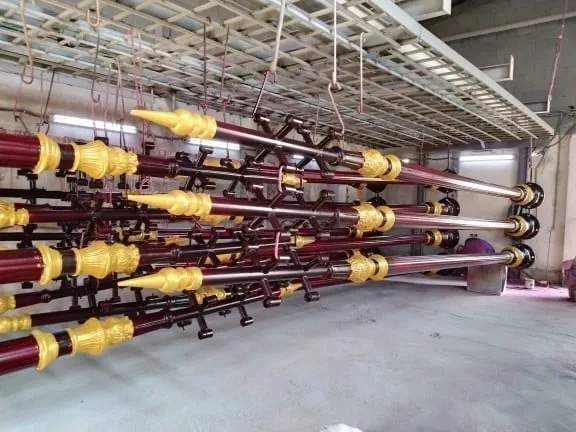
Electrostatic powder coating is the most common way to give decorative lighting poles their color and durable finish. In this process the coating powder particles are electrically charged so they are attracted to the earthed pole surface and cover it uniformly, then the pole is passed through an oven where the powder melts and cross-links to form a cohesive, smooth layer. The advantage is that this layer is thicker, more uniform, and more durable than many liquid-paint methods, and less prone to running or surface unevenness.
This method allows a wide range of finishes, not color alone; the surface can be gloss, semi-gloss, or matte, and smooth or textured, which hides minor flaws and resists visible scratches. Special finishes are also available such as metallic effects that give a metallic sheen, options that serve the project's visual identity and are chosen according to the nature of the site — corniche, garden, commercial frontage, or municipal plaza.
The quality of the powder layer is not judged by gloss alone but by its thickness, uniformity, and adhesion to the surface; thickness is measured with a suitable gauge at several points, and the surface is verified to be free of thin areas, bubbles, or non-coverage spots. Because a decorative pole is often within close view, any surface flaw shows more clearly than on a tall street pole. Typical coating thicknesses and adhesion requirements remain values to be verified against the product specification, the relevant standards, and a qualified engineer.
The Duplex system for the longest finish life
When the decorative finish is intended to last as long as possible, the strongest practical option is the duplex system: hot-dip galvanizing first, then electrostatic powder coating over it. The idea is that each layer protects the other; the outer coating slows the zinc's exposure to humidity and contaminants so it depletes slowly, while the zinc beneath provides backup cathodic protection if the coating is damaged by a scratch or impact, so the color stays clean and the metal sound at once.
The important effect is that the duplex system is not a mere sum of the two layers' lives but a multiplicative synergy well known in the corrosion-protection literature; the total life of a duplex system tends to exceed the sum of galvanizing alone and coating alone. The duplex system is therefore chosen for long-life decorative projects where maintenance or repainting is hard to repeat, such as parks, corniches, and public plazas intended to keep their appearance for many years.
The success of the duplex system depends on correct surface preparation between the layers; the zinc surface needs suitable treatment before coating so the coating adheres well and does not later delaminate. UV-resistant coating resins are chosen to stabilize the color under the sun, which matters especially in coastal areas as the corrosion-resistant coastal poles guide shows. The thicknesses of the two layers and the adhesion requirements remain values to be verified against product specifications, the relevant standards, and a qualified engineer.
RAL color matching and the project's visual identity
For color to be orderable, repeatable, and matchable, it is defined by a standard reference rather than a subjective description; the most common in pole finishes is the European RAL color guide, which gives each color a fixed numeric code (such as RAL with a specific number). This coding makes color a shared language between the project owner, the supplier, and the factory, so the color is ordered by its code rather than its description, and different batches at different times are guaranteed to match visually.
In decorative projects the color is chosen according to the visual identity of the place, not in isolation from it; pole colors for a park or garden may lean toward calm dark tones that blend with greenery, while a commercial frontage or a corporate-identity project chooses a color matching its brand, and municipal projects sometimes adhere to an approved city color palette. Linking color to the visual identity makes the poles part of the place's design rather than an alien element — a logic that integrates with the decorative-pole-design guide on its formal side.
Practically, it is advisable to fix the RAL code in the specification document from the outset, and to request an approved color sample before production starts to confirm matching on the actual surface and under site lighting, because color may look slightly different between screen, paper, and coated metal. Note that some bright or special tones may require a particular coating system or resins to maintain their stability. Matching and sample details remain procedures set with the supplier and the factory before manufacturing.
Special finishes — wood-grain and metallic effects
Alongside solid colors, special finishes are available that broaden the aesthetic options for decorative poles, the most prominent being the wood-grain finish that gives a steel pole the look of natural wood while retaining the metal's durability and protection. This finish is usually applied by a thermal-transfer technique over a base powder-coat layer, so the wood-grain pattern transfers to the surface and bonds with it, combining the warmth of a natural appearance with the durability of galvanized, coated steel.
The wood-grain finish is particularly suitable for parks, gardens, and walkways where poles are meant to blend with nature rather than stand out as overt metal elements — an option that integrates with the garden-and-public-area lighting guide. Among the documented projects, Aktar produced 160 decorative lighting poles with a wood-grain color at heights of 4 meters and 1 meter with integrated LED lighting for the Arab Revolution Park project in the Al-Baha region, a practical example of combining the wood appearance with metal durability and integrated lighting at a natural site.
Besides wood-grain, metallic effects are available that give a sheen mimicking precious metals, and textured finishes that hide fingerprints and minor scratches and suit high-touch locations, in addition to matte tones that reduce reflection. These special finishes may require extra production steps or particular resins, which is reflected in time and cost as the cost-factors guide shows. The special finish is chosen according to the nature of the site and use, with its stability and requirements confirmed with the factory before ordering.
Color stability and UV resistance in the Kingdom's climate
What most threatens the decorative appearance over the long term in the Kingdom's climate is not rust — galvanizing handles that — but color fading and gloss loss caused by intense ultraviolet radiation, long sunshine hours, and high temperatures. Coating systems vary greatly in their resistance to this effect; some resins keep their color and gloss for many years, while others fade or their surface chalks early under direct sun.
It is therefore advisable in exposed outdoor projects to choose coating systems known for color stability under ultraviolet radiation, especially for dark and bright colors that are more prone to fading than light ones. The difference between a resistant system and an ordinary one does not appear in the first year but after several years, when the gap shows between a project that kept its color and one that faded with mismatched poles. This makes color stability a criterion worth fixing in the specification rather than leaving to chance.
Color stability is also supported by simple maintenance: periodic washing to remove dust and salts preserves the surface gloss and slows its degradation, a measure that integrates with the follow-up programme in the maintenance-and-lifespan guide. UV resistance is usually measured by color- and gloss-retention indices after an exposure period, values to be verified against the approved coating system's data, the project's requirements, and a qualified engineer according to the exposure severity at the site.
How to write the finish and color into the specification
For the finish to be comparable between bids and executable without ambiguity, it is written into the specification document in measurable language rather than a general description such as 'good coating' or 'suitable color'. The useful minimum is for the specification to state: the base protection system (hot-dip galvanizing per ISO 1461 and its minimum thickness), the type of top coating (electrostatic powder), the color code (RAL with its number), the required gloss level (gloss/semi-gloss/matte), and any special finish (wood-grain/metallic/textured).
Added to that are inspectable quality requirements: coating layer thickness, adhesion acceptance criterion, a color-stability and UV-resistance requirement if the site is exposed, and a request for an approved color sample before production. This clarity makes bids comparable on a single basis and prevents misleading comparison between a durable finish and a superficial one that look alike at handover and differ fundamentally after years — an approach repeated in the road-lighting specifications guide.
Finally, the finish is linked to the project's target life rather than the lowest purchase price; a decorative project meant to keep its appearance for a full decade deserves a duplex system and UV-resistant resins, while another may suffice with a simpler system. The rule is that the true cost of a weaker finish is paid later in repainting, fading, and replacement — a logic detailed in the cost-factors guide. The numeric values in the specification remain frameworks to be verified against the latest editions of the standards, the nature of the site, and a qualified engineer.
Aktar's finishes and colors for decorative projects
At the Aktar factory in the Al-Sulai district of Riyadh, lighting poles are made to spec, which allows engineering the finishing system and color for each decorative project individually. Treatments include hot-dip galvanizing per ISO 1461 as a base, then electrostatic powder coating in RAL colors matched to the project's identity, with the option of the duplex system for longer life and special finishes such as wood-grain. Work is designed within the SASO framework, with wind-load design per SBC 301, and all regions of the Kingdom are covered with a typical delivery time of 7 to 14 business days.
Among the documented decorative projects, Aktar produced 160 decorative lighting poles with a wood-grain color at heights of 4 meters and 1 meter with integrated LED lighting for the Arab Revolution Park project in the Al-Baha region. This project embodies the guide's logic in practice: a wood-grain finish that gives the natural appearance suited to the park, over galvanized, coated steel that preserves durability, with LED lighting integrated into two poles of different heights to serve the walkways and spaces together.
Aktar's seven families cover street, decorative, garden, sports, laser-cut, walkway-and-parking, and bollard poles, together with concrete bases, in heights from 0.5 to 16 meters and higher on request, with a manufacturer warranty up to ten years per spec. For anyone planning a decorative project who wants to fix the most suitable color and finish for its environment and visual identity, the Aktar team offers a free, non-binding preliminary technical consultation via WhatsApp to help you choose the finishing system and RAL code before manufacturing.
Frequently asked questions
What is the difference between coating a galvanized pole and coating alone on decorative poles?
On a galvanized, coated pole (the duplex system) galvanizing handles rust protection at the root with cathodic protection, and the coating handles color and appearance, so the finish stays clean for more years even when scratched. Coating on ungalvanized steel opens a path for rust beneath the layer at any breach, spreading laterally and lifting the coating early. High-value decorative poles are therefore specified as a 'galvanized then coated' system.
How do I define the color of decorative lighting poles with repeatable precision?
The color is defined by a standard code from the RAL color guide rather than a subjective description, so it is ordered by its number and different batches are guaranteed to match visually. It is advisable to fix the RAL code and gloss level (gloss/semi-gloss/matte) in the specification, and to request an approved color sample before production to confirm matching on the coated metal and under site lighting.
Can a wood-grain finish be applied to a steel lighting pole?
Yes, the wood-grain finish is usually applied by a thermal-transfer technique over a base powder-coat layer, so the wood-grain pattern transfers to the surface while retaining the durability of galvanized, coated steel. It suits parks, gardens, and walkways; Aktar produced 160 poles with a wood-grain color at heights of 4 meters and 1 meter with integrated LED lighting for the Arab Revolution Park project in the Al-Baha region.
How do I ensure the color stability of decorative lighting poles under the Kingdom's sun?
Choose a coating system known for its ultraviolet resistance and stability of color and gloss, especially for dark and bright colors that are more prone to fading. Fix the color-stability requirement in the specification rather than leaving it to chance, and support it with periodic washing to remove dust and salts. Color- and gloss-retention values are verified against the approved coating system's data and a qualified engineer.