Why Drafting the Specification Clause Is a Distinct Engineering Decision
The lighting-pole item in a bill of quantities is often treated as a routine line, when it is in fact a distinct engineering and procurement decision that determines the quality, lifespan, and whole-life cost of the project for decades. A single vague phrase in the specification can open the door to a product with a thinner wall or a cheaper coating that passes delivery and then corrodes within years, leaving the owner to bear the cost of replacement and downtime. For this reason, this document differs from a guide to selecting the pole itself; it does not answer "which pole should I buy" but rather "how do I draft the text that obligates the supplier to provide the correct pole."
Some drafters confuse the product specification with the electrical and photometric performance specification for the road. These are two separate domains: road-lighting specifications under SASO and IEC address illumination levels, uniformity, glare, and luminaire class, whereas the pole clause itself addresses material, dimensions, finish, loads, foundation, and documentation. Mixing the two produces a tender that demands precise lighting performance while leaving the pole that carries it without a clear minimum for wall thickness or galvanizing, a recurring gap in municipal projects.
The aim of this guide is to enable the consultant and the municipal engineer to write a specification clause that is measurable, inspectable, and allows fair comparison between offers, or to evaluate a clause received from another party. We will break the clause down element by element — material, dimensions, height and bracket, finish, loads, foundation, conformity, testing, drawings, warranty, delivery — noting that every numeric value cited here is an approximate guideline to be verified against the latest edition of the standard, the project class, and a qualified engineer before being adopted in the document.
Material, Steel Grade, Dimensions, and Wall Thickness
A sound clause begins by defining the material precisely: the type and grade of steel by reference to a recognized standard, such as the structural steel grades in EN 10025 or an equivalent, because the phrase "good steel" or "suitable iron" obligates the supplier to nothing inspectable. Specifying the grade fixes the yield strength and tensile strength, which are the primary inputs for any subsequent load calculation, and prevents substitution of an inferior material during fabrication. It is advisable to require the material mill certificate among the delivery documents to link the supplied material to the specified grade.
Next come the dimensions: base diameter, top diameter, section shape (continuous taper, stepped, or polygonal), and tube wall thickness. Wall thickness is the element most silently shaved in low offers, because reducing one millimetre clearly lowers cost while being hard to detect by eye; the clause must therefore state an explicit minimum thickness tied to height, not a single figure for all sizes. As a guideline, thickness increases with height and is greater for tall poles, but the exact value is to be verified against the load calculation, the project class, and a qualified engineer.
It is preferable to tie the dimensions to a lighting-column design reference such as the EN 40 series, which governs column geometry, loads, and materials, rather than leaving the dimensions open to the supplier's discretion. The clause should also define the method for longitudinal and circumferential weld joints and their acceptance criteria, because weld quality is no less important than thickness to pole life under repeated wind loads. As noted in the guide to selecting pole height, dimensions and thickness follow height and function, so the clause is never written in isolation from the pole's purpose and location.
Height, Bracket, and Their Fit to Function
The clause should state the net pole height above the installation level, not merely the "overall length," because part of the pole may be embedded or mounted on a base plate, making the effective lighting height differ from the tube length. Precisely defining the mounting height of the light point is a prerequisite for any later lighting-distribution calculation and for linking the pole to the spacing calculation discussed in the guide to lighting-pole spacing. Leaving the height approximate produces a distribution different from the design and disrupts the road's photometric conformity.
The bracket is described by its length, tilt angle, number of outlets, and fixing method, in addition to the maximum luminaire load it carries. The bracket is not a cosmetic element; its length and tilt change the moment transferred to the pole top and base, and must enter the load calculation rather than be left to the supplier's choice. When the top carries several luminaires or twin mounts, the wind-exposure area increases, which the specification must reflect in a minimum thickness and base dimensions.
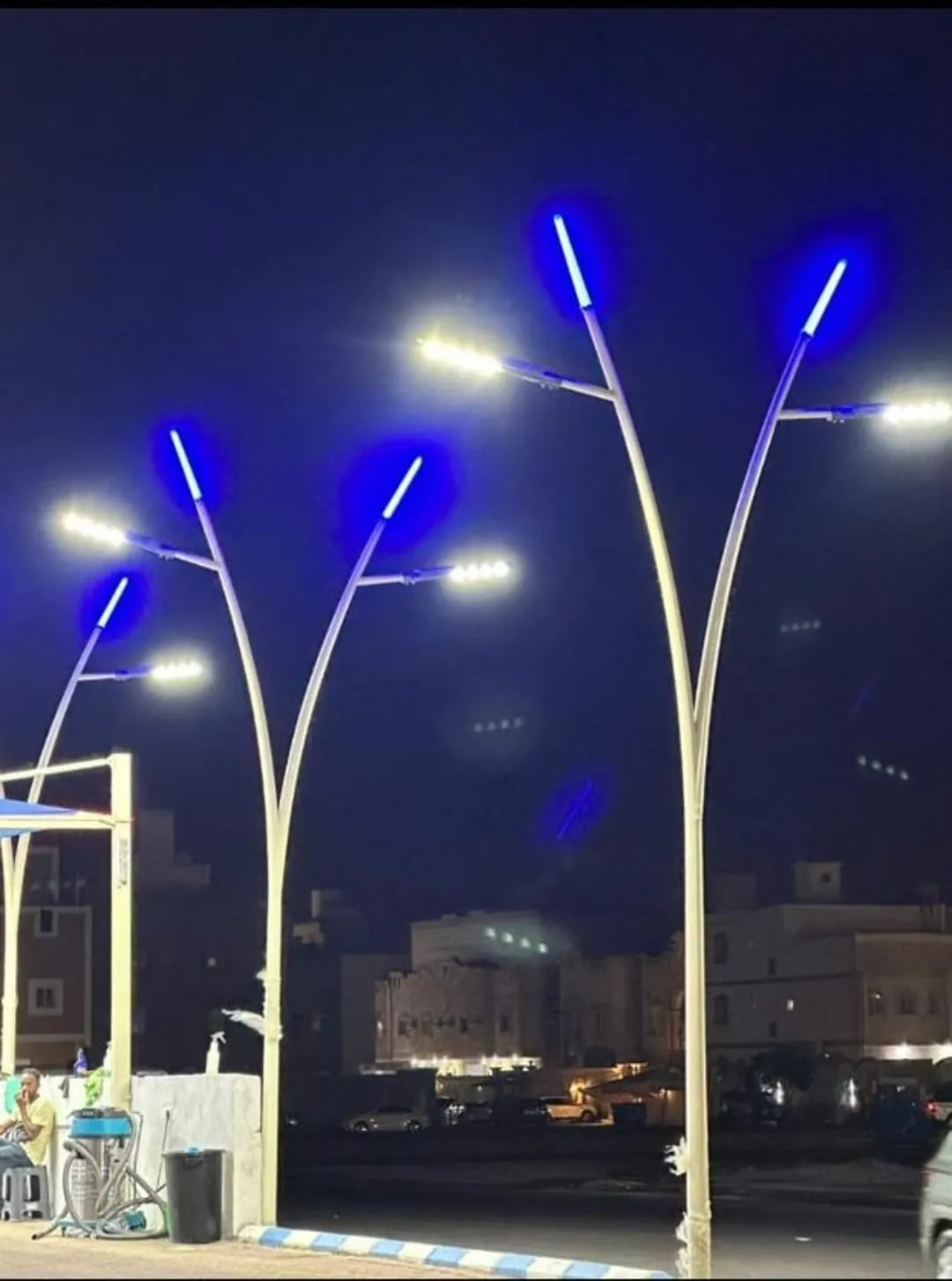
It is advisable for the clause to differentiate pole categories by function — streets, decorative, gardens, sports fields, walkways and parking, or camera mounts — because each category has a different design logic. A camera-mounting pole, as detailed in the guide to camera and surveillance poles, needs high rigidity and vibration stability at the top more than a large lighting load, while a sports-field pole follows high-mast logic. Drafting one generic clause for all these categories produces a specification that suits none of them.
Finish — Hot-Dip Galvanizing and Powder Coating
The finish is the pole's first line of defence in the Kingdom's climate, and it must be written precisely rather than in general terms. The clause should specify hot-dip galvanizing per ISO 1461, with the zinc-layer thickness measured in microns per the standard's requirements, and may reference ASTM A123 for hot-dip coating thickness requirements on iron and steel products. Stating merely "galvanized" is insufficient; the minimum micron thickness, the measurement method, and the number of measurement points are what make the clause inspectable and rejectable upon non-conformity. Every numeric thickness cited is to be verified against the latest edition of the standard, the product class, and a qualified engineer.
Many specifications require a dual system: hot-dip galvanizing first for base protection against rust, topped by electrostatic powder coating for additional protection and the required colour, especially in decorative poles. The clause should define the order of the two layers, the thickness of each, and the colour by reference to an approved colour standard, and should require adhesion and coating-resistance tests. The difference between the two systems and the cases for preferring one is explained in the guide to galvanizing versus powder coating, to which it is advisable to refer rather than repeating the details in every clause.
At locations near the coast, corrosivity intensity rises, and the specification must reflect this by increasing protection thickness or requiring a more robust finish system, referencing the corrosivity category per ISO 9223 appropriate to the site. Ignoring a site's proximity to the sea in the clause produces an actual lifespan far shorter than expected, a documented problem in coastal projects. Confirming the correct category and its corresponding protection requirements is done against the standard and with a qualified engineer according to the specific location.
Wind-Load Design, Base Plate, and Anchor Bolts
The heart of the structural specification is the wind load. The clause must state that the pole is designed per the Saudi load code SBC 301, based on ASCE 7, or the EN 40 series for lighting-column loads, specifying the design wind speed according to the geographic region and the site's exposure category. Requesting "wind resistance" alone is not enough; certified structural calculations must be required, showing the moment and top deflection under the design load, because excessive deflection may be more decisive than collapse in determining a pole's adequacy. Speeds and numeric values are to be verified against the latest edition of the code, the project class, and a qualified engineer, and the details of this calculation are explained in the guide to wind-load design for lighting poles.
This is followed by the base plate: its dimensions, thickness, number of bolt holes, and pattern are specified, because the plate is the critical joint that transfers the moment from the pole to the concrete. An insufficient plate thickness or a bolt pattern incompatible with the foundation turns the weakest point in the system into the likely point of failure. It is advisable to require stiffening gussets between the pole and the plate where the calculation requires, and to specify the plate's corrosion-protection method on a par with the pole.
As for the anchor bolts, the clause specifies their grade, diameter, length, and treatment method, and may reference ASTM F1554, which classifies anchor bolts into defined stress grades. The bolts should be supplied with a fixing template from the same manufacturer to ensure their pattern matches the base plate precisely, because a centre deviation of millimetres creates a verticality problem that is hard to adjust after the concrete is poured. Linking the bolts, foundation, and pole in one consistent calculation is a prerequisite for a sound specification, not three separate clauses that may not align.
Concrete Foundation, Earthing, and Electrical Details
The concrete foundation is part of the structural system and not a separate item left to the contractor. The specification must define the foundation's dimensions, depth, required concrete strength, reinforcement, and curing period before installation, because a deficient foundation fails the most robust pole. The foundation size is tied to the load calculation and the soil nature at the site, so a single size is not copied for all locations. The details of the foundation and installation and their time sequence are explained in the guide to lighting-pole foundations and installation, to which referral is advisable.
The clause must state earthing requirements explicitly: an internal earthing point in the pole, a clear bonding path, and connection to the earthing system per the electrical-installation requirements in IEC 60364, with lightning protection where required per IEC 62305 for exposed sites and tall poles. Neglecting earthing is a recurring safety gap in municipal specifications, and it is costly and embarrassing if discovered after installation. Specifying earthing requirements in the clause makes them inspectable and acceptable rather than merely good practice left to execution.
Likewise, the maintenance door, its position, reinforced frame, and lock are specified, as well as the internal distribution board and its protection at a suitable ingress-protection rating against dust and water per IEC 60529, since the Kingdom's dusty environment tests these details harshly. As for the luminaire itself, its electrical and photometric performance is referred to its own specification per IEC 60598 and road-lighting specifications, so that the pole clause is not mixed with the luminaire clause. A clear separation between pole and luminaire in the document prevents loading one with the other's requirements and facilitates fair evaluation of offers.
Conformity, Testing, Mill Certificates, and Approved Drawings
The specification is completed by a conformity-proof system. The clause states SASO requirements at the national level and product registration on the SABER platform where applicable, in addition to an ISO 9001 quality-management-system certificate for the manufacturing site. These are not formalities; they are what link the supplied product to a documented quality system rather than a verbal promise. It is advisable for the clause to require these certificates to be valid and submitted within the offer documents rather than after award, so that excluding a non-conforming offer is possible at the evaluation stage.
The required tests are specified precisely: galvanizing thickness measurement per the standard with the number of measurement points, coating adhesion testing, weld inspection, and a certified load calculation. The tests should be required to be conducted at an accredited inspection body and their reports delivered documented, with the possibility of taking a site sample for verification. Specifying the test method, the acceptance limit, and the accredited body is what turns the clause from an intention into a measurable commitment that can be rejected upon non-conformity.
Mill certificates for the primary materials are also required, along with approved shop drawings before fabrication begins for the consultant's approval, and an installation and maintenance manual on delivery. Approving the drawings before fabrication reveals deviations early and saves costly review cycles later on site. The absence of this requirement makes final delivery the first opportunity to discover an error, when correction is far harder and more expensive for both parties.
Warranty, Delivery, and Avoiding Open Clauses and "Or Equivalent"
The clause must state a written warranty covering the soundness of the pole and its finish against manufacturing defects and abnormal corrosion for a clearly defined period, specifying what the warranty includes and excludes and the claim mechanism. A warranty without a definition of its scope, period, and mechanism is a formal warranty with no enforceable value. Delivery terms are also specified: the supply period, place, responsibility for transport and unloading, and packaging condition, with a realistic schedule consistent with the project programme rather than a loose period that disrupts planning.
The most dangerous thing that weakens a specification is the open, vague clause: "suitable steel," "sufficient thickness," "good galvanizing," "weather resistant." Each of these phrases opens the door to the lowest product that ostensibly passes, and strips the consultant of the ability to reject a non-conforming offer at evaluation. The remedy is to replace every open qualitative description with a measurable value tied to a standard and an inspection body: a minimum thickness, a micron galvanizing thickness, a steel grade, a design wind speed, a bolt grade, a warranty period.
As for the phrase "or equivalent," it is legitimate to avoid restricting competition to a single brand, but it becomes a loophole if not constrained by explicit equivalence criteria. The sound drafting is to follow it with a condition that the "equivalent" prove its equivalence based on the same standards, tests, and certificates stipulated, and that the proof of equivalence be submitted for approval before supply, not after. Thus competition remains open while the quality ceiling stays protected, the balance that distinguishes a well-built lighting-pole tender document from a loose one.
Aktar as a Partner in Preparing and Executing the Specification Clause
Aktar operates from its factory in the Al-Sulai district of Riyadh, manufacturing seven pole families — streets, decorative, gardens, sports fields, laser-cut, walkways and parking, and bollards — in addition to concrete foundations, at heights from half a metre up to sixteen metres and higher on request. The poles are executed with hot-dip galvanizing per ISO 1461 followed by electrostatic powder coating, and their capacity is designed for wind loads per the Saudi code SBC 301, with conformity to SASO requirements, made to the required specification and supplied to all regions of the Kingdom with a typical delivery period of seven to fourteen business days.
Among the documented examples of a fully executed specification is the Ashwaq Municipality project in Tabuk, where two hundred and fifty decorative poles eight metres in height were supplied per the project specification and with a documented completion certificate from Aktar. Such a practical reference helps the owner link the tender clauses to an actually delivered product rather than a theoretical promise, and makes it easier for the consultant to calibrate its numeric limits according to the project class and location. Every project has a unique requirement and an independent engineering calculation according to height, location, and function.
Aktar's technical team can review the draft lighting-pole clause in the tender document before the tender is issued, or scrutinize an offer received by the entity to verify its conformity with the stipulated specification, preparing the necessary technical documents, calculations, drawings, and certificates. As noted in the guide to choosing a lighting-pole factory, documentation of origin and conformity is what distinguishes the serious supplier. For a free, non-binding preliminary technical consultation on drafting or evaluating the specification clause, contact the Aktar team via WhatsApp to discuss the details of your project.
Frequently asked questions
What elements must the lighting-pole specification clause include in a tender?
A complete specification clause includes: material and steel grade, dimensions and wall thickness, height and bracket, finish (hot-dip galvanizing per ISO 1461 and ASTM A123 at a defined micron thickness with powder coating), wind-load design per SBC 301 or EN 40, base plate and anchor bolts per ASTM F1554, concrete foundation, earthing, conformity to SASO, SABER, and ISO 9001, testing and mill certificates, approved shop drawings, warranty, and delivery. Every numeric value is to be verified against the latest edition of the standard, the project class, and a qualified engineer.
What is the difference between a lighting-pole tender document and road-lighting specifications?
A lighting-pole tender document addresses the pole itself: material, dimensions, finish, loads, foundation, and documentation — that is, the drafting of the procurement document that obligates the supplier. Road-lighting specifications under SASO and IEC, by contrast, address electrical and photometric performance: illumination levels, uniformity, glare, and luminaire class. These are two separate domains that must be separated in the document so that the pole clause is not loaded with the luminaire's requirements or vice versa.
How do I avoid open clauses and the phrase "or equivalent" in lighting-pole specifications?
Replace every open qualitative description, such as "suitable steel" or "good galvanizing," with a measurable value tied to a standard and an inspection body: a minimum thickness, a micron galvanizing thickness, a steel grade, a design wind speed, a bolt grade, a warranty period. The phrase "or equivalent" should be constrained by a condition that the equivalent prove its equivalence per the same standards, tests, and certificates, and that the proof of equivalence be submitted for approval before supply, not after.
What certificates and tests are usually required in lighting-pole specifications?
Usually required are a SASO conformity certificate and SABER registration where applicable, an ISO 9001 certificate for the manufacturing site, a galvanizing-thickness measurement report per the standard with the number of measurement points, a coating adhesion test, weld inspection, load calculations certified by a qualified engineer, and material mill certificates. It is advisable to require the certificates to be valid and within the offer documents rather than after award, so that excluding a non-conforming offer is possible at evaluation.